by jboullion | Mar 5, 2010 | Uncategorized
From the newsletter of the People’s Food Co-op:
People’s Food Co-op and its partners, the Bluff Country Co-op in Winona, MN, and the Viroqua Food Co-op, are pleased to announce the 4th annual request for proposals for the Coulee Region Cooperative Community Fund Grant. This grant fund was established in 2003 by the People’s Food Co-op with a mission to provide supplemental or project-specific funding to local nonprofit organizations that have missions consistent with the goals of our co-ops.
Priority is given to grant requests for educational projects, development projects and events that have a focus on, but are not necessarily limited to, food and food systems, nutrition, health and well-being, sustainable agriculture, cooperative education and social change.
Applications should be received by Thursday, April 15, 2010, at 5 p.m.
Applications can be submitted electronically to liz@bluff.coop
or mailed to: CRCCF Grant Committee, c/o Bluff Country Co-op
121 W 2nd Street
Winona, MN, 55987
The grant committee will complete its review by the end of May and awardees will be contacted. Application forms, directions and more information about the CRCCF can be found at the web site (www.bluff.coop). Questions can be directed to Liz Haywood, General Manager, at 507.452.1815, or liz@bluff.coop.
Past recipients of the CRCCF awards have included Coulee Children’s Center, the Cornucopia Institute, Pleasant Ridge Waldorf School, La Crescent-Hokah Community Gardens, the Women’s Resource Center of Winona, Riverway Learning Community and Houston Community Gardens.
by jboullion | Mar 5, 2010 | Uncategorized
From an article by Kim Shankland in The Pointer (UW-Stevens Point):
Now that we’ve taken a look at the renewable energy sphere, let’s take a look at one of the leaders in the industry. The Midwest Renewable Energy Association is a non-profit organization located just nine miles east of the University of Wisconsin-Stevens Point in Custer, Wis.
The MREA’s mission is to promote renewable energy, energy efficiency and sustainable living through education and demonstration. They are considered a national leader in the renewable energy field. In fact, the organization recently received a $3.3 million grant from the Department of Energy to organize a regional solar training network.
This organization is a great resource for UWSP students who would like to get into the field or learn more about energy efficiency and renewable energy practices.
The MREA strives to train and educate through the classes, internships and volunteer opportunities they provide. They hold workshops to educate people on the best way to use renewable energy in their houses or businesses and counsel people on how to be more energy-efficient.
MREA property includes a newly built classroom building to conduct more workshops at once. They also have training roofs for students, in order to practice installing solar panels in their installation workshops.
“A great way to get a basic introduction to renewable energy is to take our workshops. All of our basic 101 workshops are one day. It’s a nine to five class that can teach you about solar electric/solar hot water wind energy – one class for each technology. It’s a great way to see if you’re interested in it before you pursue it,” said Gina Sinisi, communications coordinator for the MREA.
The energy fair is an influential event for the MREA, community members and people involved in the renewable energy field all over the nation. Held each June, this event takes place at the ReNew the Earth institute on the MREA property in Custer.
The fair is host to thousands of people from all over the U.S. who connect with and learn from each other as they eat, drink, listen to music and camp.
by jboullion | Mar 5, 2010 | Uncategorized
From a letter by PSC Chair Eric Callisto to the special committees on clean energy jobs:
. . . [W]hat follows is a summary of preliminary PSC cost modeling of the RPS and energy efficiency components of the CEJA. . . .
The modeling shows that in every case in which GHGs are monetized (i.e., there is a compliance cost associated with emitting GHGs), the cost of the CEJA is less than the cost of the status quo over the long run. That is, we will in all likelihood be spending more on electricity in the long run if we don’t act now and enact enhanced renewable portfolio standards and take more aggressive action on energy efficiency. . . . (Note: emphasis in original letter)
Table 4 (Note: Tables 1 – 3 were deleted for this summary) shows the forecasted impact of the proposed legislation on monthly electricity bills for an average residential customer. As in previous tables, these values show the incremental impact of the CEJA compared to the Status Quo. For example, the table indicates that monthly bills will be $1.08 lower under CEJA than under the Status Quo if GHG emissions cost $10/ton. Monthly bill impacts were not calculated for commercial and industrial customers because bills in those customer classes vary more widely than residential bills. . . .
by jboullion | Mar 4, 2010 | Uncategorized
Excerpts of a letter from PSC Chair Eric Callisto to the special legislative committees on clean energy jobs:
February 19, 2010
Assembly Special Committee on Clean Energy Jobs
Wisconsin State Assembly
Madison, WI 53702
Dear Committee Members:
I am writing in response to a letter dated February 9,2010 from Representatives Huebsch, Montgomery, and Gunderson requesting a Commission analysis of the expected costs to utilities and ratepayers of meeting a 25% by 2025 Renewable Portfolio Standard (RPS) as proposed in the Clean Energy Jobs Act. As I have testified to both the Assembly and Senate Select Committees, the electric utility sector policies in the proposed legislation – namely, the enhanced RPS and energy efficiency provisions – represent sound energy policy for Wisconsin. The Commission’s analysis shows that if we continue with business as usual, if we decide to do nothing, we are taking on great financial risk in a changing world, and our ratepayers will be leaving substantial dollars on the table.
. . . [W]hat follows is a summary of preliminary PSC cost modeling of the RPS and energy efficiency components of the CEJA. PSC staff modeled the costs of the RPS and energy efficiency policies together, because the RPS requirements are expressed as a percentage of retail electricity sales. It would be unrealistic to estimate the costs of the RPS requirements in the proposed legislation while ignoring that the same legislation seeks to reduce the growth in demand for electricity. The two policies are inherently connected.
The modeling shows that in every case in which GHGs are monetized (i.e., there is a compliance cost associated with emitting GHGs), the cost of the CEJA is less than the cost of the status quo over the long run. That is, we will in all likelihood be spending more on electricity in the long run if we don’t act now and enact enhanced renewable portfolio standards and take more aggressive action on energy efficiency. . . . (emphasis in original letter)
by jboullion | Mar 4, 2010 | Uncategorized
Excerpts of a letter from PSC Chair Eric Callisto to the special legislative committees on clean energy jobs:
February 19, 2010
Assembly Special Committee on Clean Energy Jobs
Wisconsin State Assembly
Madison, WI 53702
Dear Committee Members:
I am writing in response to a letter dated February 9,2010 from Representatives Huebsch, Montgomery, and Gunderson requesting a Commission analysis of the expected costs to utilities and ratepayers of meeting a 25% by 2025 Renewable Portfolio Standard (RPS) as proposed in the Clean Energy Jobs Act. As I have testified to both the Assembly and Senate Select Committees, the electric utility sector policies in the proposed legislation – namely, the enhanced RPS and energy efficiency provisions – represent sound energy policy for Wisconsin. The Commission’s analysis shows that if we continue with business as usual, if we decide to do nothing, we are taking on great financial risk in a changing world, and our ratepayers will be leaving substantial dollars on the table.
. . . [W]hat follows is a summary of preliminary PSC cost modeling of the RPS and energy efficiency components of the CEJA. PSC staff modeled the costs of the RPS and energy efficiency policies together, because the RPS requirements are expressed as a percentage of retail electricity sales. It would be unrealistic to estimate the costs of the RPS requirements in the proposed legislation while ignoring that the same legislation seeks to reduce the growth in demand for electricity. The two policies are inherently connected.
The modeling shows that in every case in which GHGs are monetized (i.e., there is a compliance cost associated with emitting GHGs), the cost of the CEJA is less than the cost of the status quo over the long run. That is, we will in all likelihood be spending more on electricity in the long run if we don’t act now and enact enhanced renewable portfolio standards and take more aggressive action on energy efficiency. . . . (emphasis in original letter)
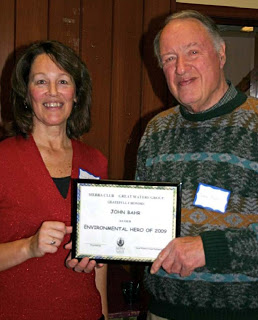
by jboullion | Mar 4, 2010 | Uncategorized
From the newsletter of John Muir Chapter of the Sierra Club:
At the annual Great Waters Group Holiday Party, John Bahr was named this year’s GWG Environmental Hero. Each year a volunteer receives this honor for his or her efforts in “Exploring, Enjoying, and Protecting the planet.”
John has worked diligently for the past five years on the issue of global warming and energy conservation. He has raised awareness of this important problem through talks to anyone who will listen and through meetings with civic and business leaders. He has targeted his home community of Wauwatosa, helping it develop practical ways to reduce its energy use.
He now sits on a Wauwatosa committee that is developing a strategy to make the entire community a “Cool City.” Congratulations, John. The Great Waters Group stands behind you in all your efforts.
by jboullion | Mar 4, 2010 | Uncategorized
An announcement from Wisconsin Environment, IBEW, Helios USA, Access Solar, Clean Wisconsin, Sierra Club, Milwaukee River Keeper:
Come join us Thursday, March 11th at 6:00 p.m. for a Clean Energy Town Hall Forum.
A panel of experts will discuss how the Clean Energy Jobs Bill will benefit the greater Milwaukee area with green jobs, lower energy bills and a cleaner, healthier environment.
Plus, talk with local installers about rebates and incentives to use energy efficiency or renewable energy for your home or business.
Speakers include: Dan Kohler, Director of Wisconsin Environment; Steve Ostrenga, CEO of Helios USA; Dave Boetcher, Government Affairs Coordinator for IBEW, Senator Jim Sullivan of the 5th District; Susan Stratton, Executive Director of Energy Center of Wisconsin and Matt Frank, DNR Secretary
Co-Sponsors: Wisconsin Environment, IBEW, Helios USA, Access Solar, Clean Wisconsin, Sierra Club, Milwaukee River Keeper
Any questions contact Lindsay North at (608) 287-0867. RSVP here!
West Allis Public Library
7421 W. National Ave
Constitution Room
West Allis, WI 53214
by jboullion | Mar 3, 2010 | Uncategorized
From an article by Nathaniel Shuda in the Wisconsin Rapids Tribune:
A Canadian energy producer’s latest effort to build a wind farm on the Great Lakes is one of several projects industry officials say is spurring interest in the concept.
The Great Lakes basin serves as a prime location for offshore power facilities because of high wind volumes and space, industry leaders said, which has some south Wood County business leaders poised to take advantage of what they call an invaluable resource.
“It costs a lot more to construct a tower in the water than it does on land, but when you put wind turbines on land, they’re set away from cities, so you need transmission lines,” said Jenny Heinzen, a wind-energy technology instructor at Lakeland Technical College. “What you’re spending in construction is far less than what you’d spend in transmission costs.”
Toronto-based Trillium Power Wind Corp. is gearing up for its planned 710-megawatt offshore wind facility in the middle of Lake Ontario that would power at least 300,000 homes a year in the Canadian province, according to a news release the company issued Thursday.
Its project, which also has connections to Denmark-based wind-energy component producer Vestas Wind Systems, is just one of many recent events the top executive of a Wisconsin Rapids-based manufacturer says further support the company’s plans to build what officials now say is a 535,000-square-foot $70 million wind turbine blade plant in the Rapids East Commerce Center.
“The market has validated our conversation,” said Sam Fairchild, chief executive officer of Energy Composites, which launched a Great Lakes Consortium in August to help promote the Great Lakes region within the wind-energy industry.
by jboullion | Mar 3, 2010 | Uncategorized
From an article in the Milwaukee Journal Sentinel by Tom Daykin:
The decision by Spanish train maker Talgo to locate its first U.S. assembly plant at the former Tower Automotive site on Milwaukee’s north side will have a bigger payoff than the 125 jobs it will create, a company executive and public officials said Tuesday.
Talgo will expand and add jobs if the company sells more trains, Chief Executive Officer Antonio Perez said Tuesday. Talgo already has orders for at least four trains from the states of Wisconsin and Oregon, and it hopes to sell several trains to other states with new high-speed rail lines, said Perez and Gov. Jim Doyle.
Also, while Talgo will import train car shells from Spain, it will buy other components from U.S. suppliers, Perez said. Those vendors could include Milwaukee-based Super Steel Products Corp. and Oak Creek-based Milwaukee Composites Inc. Such supplier contracts are expected to create around 450 jobs throughout the Midwest, Doyle said.
Finally, Talgo’s facility at the former Tower site boosts the city’s efforts to create a business park there, said city Development Commissioner Rocky Marcoux. That business park, dubbed Century City, will eventually have an estimated 700 to 1,000 jobs, he said.
Much of this, however, depends on developing a national high-speed rail system – financed with an initial investment of $8 billion in federal stimulus tax funds – that critics believe will draw fewer passengers than expected.
Talgo said Tuesday it will soon begin assembling trains in Milwaukee. Perez said the company will begin work between June and September and is already recruiting employees. About 60 positions are needed to build trains and another 65 jobs for maintenance work, he said.
by jboullion | Mar 2, 2010 | Uncategorized
From a news release issued by Clean Wisconsin:
Madison, Wis – Despite big oil and coal spending hundreds of thousands of dollars trying to confuse and turn the public against the Clean Energy Jobs Act, Wisconsin residents and businesses demonstrated overwhelming support for the bill in recent legislative hearings, with supporters outnumbering opponents by more than a 2 to 1 ratio, according to data recently obtained from the Wisconsin State Legislature.
“Attendance at the hearings shows that Wisconsinites support the Clean Energy Jobs Act, despite the attempts of big oil and coal lobbyists to sour public perception with misinformation and deceptive advertising,” said Keith Reopelle, Senior Policy Director at Clean Wisconsin. “Energy independence may be bad for the big oil and coal companies, but it’s good for the hard-working people of Wisconsin.
Supporters of this bill realize that greater energy independence means higher profits for Wisconsin businesses, more jobs, and a cleaner, healthier environment.”
In an attempt to weaken the Clean Energy Jobs Act, Wisconsin Manufacturers and Commerce (WMC) and big oil and coal companies have flooded the capital with lobbyists and spent hundreds of thousands of dollars on advertisements and studies that use biased, outdated and discredited information to attack the bill.
Despite this misinformation campaign, individuals supported the bill 2 to 1 at recent legislative hearings, with actual businesses supporting the bill by a 3 to 1 margin.