by jboullion | Feb 6, 2009 | Uncategorized
From a media release issued by CREWE:
(MADISON, Wis.) – Leading Wisconsin companies are joining forces to advocate for the meaningful global warming policy changes proposed by the Governor’s Global Warming Task Force (GWTF).
The business coalition named Clean, Responsible Energy for Wisconsin’s Economy (CREWE) looks forward to working with other members of the GWTF, the Doyle Administration and other companies and organizations to push for the adoption of policies that effectively and responsibly address global warming and capture the economic development and environmental opportunities in Wisconsin, said CREWE Board Chairman Dan Ebert.
“Wisconsin is poised for a transition to a sound economy powered by good, new, green jobs,” Ebert said. “CREWE was formed around the belief that a sustained and shared partnership of government, business and citizens is needed to build a clean energy and reliable future that will benefit all Wisconsin residents and businesses.”
Coalition members include Wisconsin Energy Corp., Madison Gas & Electric, Orion Energy Systems, American Transmission Co., Johnson Controls, MillerCoors, WPPI Energy, Potawatomi Tribe and C5-6 Technologies.
CREWE is dedicated to joining forces with other supporters to promote responsible policies that address climate change, create jobs, promote energy efficiency, reliability and independence, and mitigate the economic impacts of rising energy costs, Ebert added.
by jboullion | Feb 6, 2009 | Uncategorized
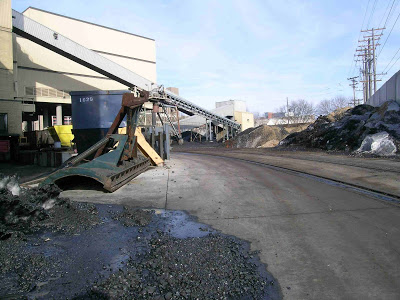
The Charter Street heating plant on the campus of the UW-Madison will switch from coal to biomass before the end of 2010.
From an announcement from Governor Doyle:
MADISON—Governor Jim Doyle announced today that a new biomass boiler will be installed at the Charter Street Heating Plant as part of his commitment to stop burning coal at state-owned heating plants on Madison’s Isthmus.
“We must move away from our dependence on coal,” Governor Doyle said. “This new project will help build the biomass market in Wisconsin, keep the money we spend on energy in the local economy and create green jobs in the area.”
The new biomass boiler will be capable of burning up to 100% biomass, everything from wood chips to switchgrass pellets, and will eventually be able to burn about 250,000 tons of biomass per year. This demand for biomass will help create and sustain a biomass market in Wisconsin and provide economic benefit for landowners, farmers and processors in the state.
With the switch to biomass, there will be 108,800 fewer tons of coal burned in the area each year and lower particulate emissions. Reducing particulate emissions by moving away from coal at the Charter Street Heating Plant is a key step in working to improve air quality in Dane County and moving the County back into attainment.
A media release from Better Environmental Solutions highlighted the importance of biomass production to southwestern Wisconsin:
“Planting switchgrass is a great crop for our highly erodible fields,” said Jim Schaefer, a Platteville area farmer. “We want create more markets for grass and other biomass crops for energy and fuels.”
Southwest Badger RC&D has been working with farmers and researchers on six switchgrass test plots and ways to collect woody biomass to restore native prairie and switchgrass and woodlands.
“The state’s demand for biomass will help farmers promote more conservation practices and give us cleaner water and reduced flooding,” said Steve Bertjens, NRCS Southwest Badger RC&D coordinator.
by jboullion | Feb 6, 2009 | Uncategorized
From an article in the Stoutonian:
In a report released by Wisconsin’s Department of Administration, the University of Wisconsin-Stout has once again been found to be the most energy-efficient campus in the UW System.
The report “Energy Use in State-Owned Facilities” based its findings on the energy consumption of all UW campuses. Energy consumption is monitored through the campuses’ utility bills and fuel consumption. UW-Stout has led the UW System in energy efficiency for over 10 years. Last year, the report found UW-Stout to be 30 percent more efficient than the UW System’s average.
According to UW-Stout’s media release and Physical Plant Director Ted Henzel, energy efficiency comes from the precise maintenance and cleaning of the school’s physical plant by UW-Stout’s maintenance workers.
by jboullion | Feb 5, 2009 | Uncategorized
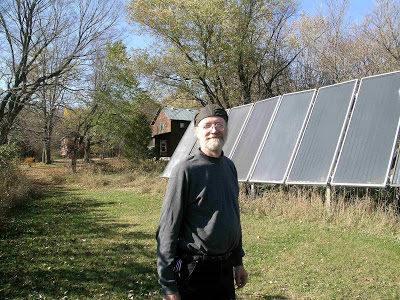
Bob Ramlow stands in front of the solar hot water panels at the Artha Sustainable Living Center near Amherst.
From the newsletter of RENEW Wisconsin:
With his graying hair in a pony tail and his hand-rolled cigarettes, Bob Ramlow projects the classic appearance of an aging hippie who parted company with the rat race decades ago. And not only does he look every inch the solar energy pioneer, he is one, mentoring installation contractors and counseling prospective system owners in his capacity as Focus on Energy’s solar water heating technical consultant. Indeed, a typical day presents Ramlow with many opportunities to apply his 30+ years of experience in this area, whether it involves reading over site assessments, reviewing drawings and equipment specifications, or advising contractors whenever an installation presents an unusual challenge. . . .
Do you mind being called an aging hippie?
Not at all. I was one of many who “tuned in, turned on, and dropped out.” I wanted a fixer-upper with good soil and woods, and I bought the farmland with a nearly ruined farm house built in 1911. We farmed it for 20 years. The old house became the bed and breakfast after we built our new house in 2006.
When did your solar addiction begin?
In 1971. Dr. George Becker, a fisheries professor, supervised my independent study in my senior year in Natural Resources at the UW-Stevens Point.
One day, he told me that “we’re going for a walk” to his house. In his backyard, he had something that looked like an A-frame outhouse. It had an air collector facing the sun, and it was full of rocks to store heat. An air pump blew into his house.
I saw that, and a light went on! You could get depressed fighting nukes and DDT, like we did then, but here was something positive!
Did the Midwest Renewable Energy Association (MREA) begin about this time?
The MREA came a lot later – 1990 – after I’d spent several years of selling high-quality wood stoves, working for a company selling wall mounted air collectors, then another company that sold windows and doors with home installation as a sideline, and I formed Artha Renewable Energy as a solar consulting business in 1976.
Mick Sagrillo, now the solar electric consultant for Focus on Energy, and a lot of us in the area were doing a lot of good things by the late 1980s, when George Perez, publisher of Home Power magazine, told us we should strut our stuff – hold fairs and festivals to show off renewable energy.
We liked the idea and founded the MREA in January or February of 1990. We held the first fair at the county fair grounds in Amherst in mid-August of the same year. The first day – Saturday — it rained hard. The four holy, moldy Korean-War-era tents, where we held workshops, let the rain pour in. People were squatting on chairs to stay out of the water while they listened to the presentations. Sunday was beautiful. We had 3,000 people and made enough money to hire a part-time director for the next year’s fair.
What exactly do you do for Focus on Energy?
I mentor solar hot water installers and dealers. Installers call me a lot. They run into a situation that’s unfamiliar, or maybe they aren’t sure exactly how to squeeze all of the equipment into a tiny space, for instance. I help with nuts and bolts issues. I review solar site assessments too – probably one a day on the average.
Focus on Energy’s call center also refers homeowners, business owners, and school district staff to me when I seem to be the most appropriate person, though most people call their utility or a dealer first.
Sometimes for Focus on Energy and sometimes for the MREA, I teach classes, often to employees of heating and plumbing contractors. We’re currently working out the details for me to train installers for one of the largest contractors in the state.
by jboullion | Feb 5, 2009 | Uncategorized
From a story on WXOW News 19:
La Crosse, WI (WXOW)- Gundersen Lutheran is one step closer to becoming energy independent thanks to the La Crosse City Brewery.
“People in the La Crosse community have seen these flares for many years and we approached City Brewery and said this would be a unique partnership and a wonderful partnership to capture this waste methane, waste energy, going right now and just being released,” says Corey Zarecki, efficiency improvement leader at Gundersen Lutheran.
The combined heat and power project is located on the City Brewery’s Property.
Waste methane gas discharged from the Brewery’s waste treatment process is being turned into electricity. The process is expected to generate three million Kilowatt hours per year.
“We’re gonna be generating electricity and putting that to the grid as clean renewable energy source,” says Corey Zarecki.
The project is expected to generate 8 to 10 percent of the energy used at Gundersen Lutheran’s La Crosse and Onlaska facilities. That is enough electricity need to power 280 homes.

by jboullion | Feb 5, 2009 | Uncategorized
The Renewable Energy Summit opened online registration for the event at the Midwest Airlines Center, Milwaukee, March 25 – 28, 2009.
Fifteen program themes highlight bio industry energy; business technologies and practices; curriculum programs and course design; energy efficiency, energy management and renewable, sustainable and green practices; energy policy, legal issues, drivers of the energy revolution, and opportunities for funding; green career pathways; green manufacturing; greening practices for colleges; green transportation; solar electric energy; solar thermal and geothermal energy; utility issues; water technologies; and wind energy.
March 25 and 26 focus on the renewable energy industry with presentations on all sectors of the industry. March 27 features Green Career Day with the focus on educational and job opportunities. March 28 offers workshops and short courses at the MATC Oak Creek Campus. For details see www.renewableenergysummit.org.
by jboullion | Feb 5, 2009 | Uncategorized
From an article by Debbie Griffin in the River Falls Journal:
For the first time ever, River Falls made the Environmental Protection Agency’s list of top 21 Green Power Communities in the country. The city made number 10 to be exact, with a 5% participation rate and deriving 15% of its energy from renewable sources.
Not only is it River Falls’ first time on the list, but also it’s the first city in Wisconsin or the Midwest to make it.
River Falls Municipal Utilities Communication Coordinator Chris Blasius said RFMU has been eyeing the list for years, waiting to apply for the status if and when River Falls ever met the EPA’s criteria. The city hit that magic mark this year.
Blasius said the main thing that landed the city on the list is how much it spends on renewable energy.
by jboullion | Feb 4, 2009 | Uncategorized
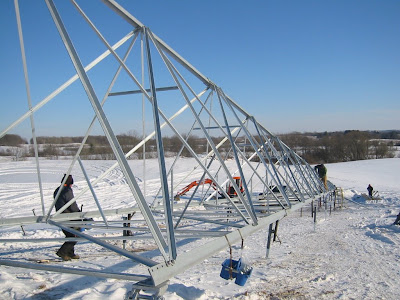
A crew prepares a tower for the wind turbine at Dave’s Brewfarm™.
From a news release issued by Dave’s Brewfarm™, Wilson, WI (St. Croix County):
. . .we’ll be putting up a Jacobs 31-20, a 20kW wind generator on a 120-foot tower to harvest the bountiful winds on the northern ridge of Wilson. The generator is projected to provide up to 50% of the needed electricity for the brewery/residence.
The wind generator is but one component of the sustainable aspect of the BrewFarm project, with geothermal heating/cooling and solar thermal rounding out the renewable energy mix. Greywater recycling will handle the brewery’s wastewater, which will be used in the hopyard and orchards of Little Wolf Farmstead, the agricultural component of the project.
The BrewFarm is an innovative demonstration project showcasing the latest in renewable and sustainable business practices, and rural development. Our hope is that through “leading by example” other businesses will adopt these (and other) sustainable strategies, realizing that every effort helps the planet – and the bottom line.
by jboullion | Feb 4, 2009 | Uncategorized
From an article by Tom Kertscher in the Milwaukee Journal Sentinel:
Oak Creek – An explosion Tuesday morning inside a We Energies coal dust silo rained flames down on a group of contract employees who were making preparations for repair work to begin.
Four employees were inside the 65-foot-tall structure and two outside when the explosion occurred, said a We Energies spokesman. A doctor said a 43-year-old man pulled his son, 22, and at least one other co-worker to safety.
The 22-year-old was the most severely injured, suffering burns to more than half his body, according to Tom Schneider, medical director of the Columbia St. Mary’s Regional Burn Center in Milwaukee.
The cause of the blast, reported at 10:53 a.m., has not been determined. Federal and local authorities will be investigating, officials said.
The six workers are employees of the Milwaukee branch of ThyssenKrupp Safway, a Waukesha-based company that provides scaffolding services, said Michelle Dalton, a company spokeswoman. She would not identify the workers.
ThyssenKrupp was hired as a subcontractor by United States Fire Protection, a New Berlin firm that provides fire protection services, according to We Energies spokesman Brian Manthey.
by jboullion | Feb 3, 2009 | Uncategorized
From an editorial in The Country Today:
We hear it all the time in rural Wisconsin communities: “We don’t want that wind farm, large dairy operation or anaerobic digester in our neighborhood.”
The not-in-my-backyard mentality hasn’t gone away and it isn’t likely to anytime soon.
The NIMBY attitude really isn’t so hard to understand. If someone lived in a peaceful rural neighborhood and that person had a choice, he or she probably would opt not to have that tranquility disrupted by a large business being built next door, whether it be an ethanol plant, a hog confinement operation or a widget factory.
It would be quite unusual to hear, “Please don’t build that in my backyard, build it in my front yard!”
Within the past week, stories have crossed our desks about a large dairy project near Rosendale, a Manitowoc County wind farm and a community animal-manure digester project in Dane County.