by jboullion | Oct 29, 2008 | Uncategorized
From Focus on Energy:
It’s a great time to protect the environment, reduce your carbon footprint and save money in the long run. Do it all by installing a solar electric or solar hot water system.
Solar electric systems: capture solar energy and transform it into electricity. Click here to learn more and see how solar electric systems work.
Solar hot water systems: use the sun to heat water and then store it for extended periods, right on your property, making plenty of hot water available for showers, laundry and dishes. Click here to learn more and see how solar hot water systems work.
Right now, there are valuable financial incentives available that can significantly reduce the cost of these systems:
+ Federal tax credits
+ Cash-Back Reward of up to 25% for project costs
+ Site Assessment co-funding of up to 60%
+ An additional $500 bonus for owners of Wisconsin ENERGY STAR® Homes or existing homes that have gone through the Home Performance with ENERGY STAR Program
+ For multi-family buildings or other businesses, implementation grants are available to install solar projects
Visit focusonenergy.com/renewable to learn more about solar and available financial incentives or to sign up for our Renewable eNewsletter.
by jboullion | Oct 29, 2008 | Uncategorized
From an article by Mary Beth McCauley in The Christian Science Monitor:
The buggy is in the drive. Trousers flutter on the clothesline. Horses prance as they work the field, their manes flowing, their step high. And mounted there on the shed out back are, well, solar panels – looking as if this Hollywood-set Amish family somehow stumbled into the Philadelphia Home Show.
Solar energy has been used by a few of the technology-eschewing Amish for decades now. But with soaring energy costs, more families are putting sunlight-collecting panels on their barns and outbuildings. Indeed, area dealers report sales of solar systems to the Amish are up 30 percent to 50 percent this year alone.
Unlike the non-Amish – who tend to favor large alternative energy systems that connect directly to the public utility grid – Amish prefer simple stand-alone systems. They use solar panels to power a battery for a specific task – such as running the lights on a buggy or operating a woodshop motor. The don’t use electricity inside the home. Solar energy is replacing propane, gas, or diesel to run small motors on farms and in businesses.
“The solar power system is really simple – a couple of panels and a battery,” says Sam Zook, of Belmont Solar, in Gordonville, Pa.
Isn’t this still a bit high-tech for the horse and buggy set?
Not at all says Mr. Zook. “The Amish are not completely disconnected from the outside world. There’s always someone running a retail store [nearby] and introducing a new item.”
Whether these are accepted or not is up to church leaders, and rulings differ from congregation to congregation and district to district. Cars and electricity tend to be rejected. And solar is not accepted everywhere yet, says Zook, even here in Lancaster County, which is considered one of the nation’s more progressive settlements of Amish.
by jboullion | Oct 29, 2008 | Uncategorized
From an Associated Press article posted on INO.com News:
(AP:MILWAUKEE) Electric and natural gas utility Wisconsin Energy Corp. said Wednesday its third-quarter profit fell 7 percent as cool summer weather lowered demand for air conditioning.
For the quarter ended Sept. 30, Wisconsin Energy earned $77.5 million, or 65 cents per share, compared with $82.9 million, or 70 cents per share, for the same quarter in 2007.
Earnings from continuing operations _ which excludes results from businesses that have been, or are in the process of being sold _ totaled $77 million, or 65 cents per share, compared with $83.1 million, or 71 cents per share, in the year-ago quarter.
Revenue declined 3 percent to $852.5 million from $881.5 million in the 2007 period.
On average, analysts polled by Thomson Reuters expected a more modest profit of 55 cents per share, on $892.8 million in revenue.
Wisconsin Energy said residential use of electricity fell 5 percent in the quarter from a year ago. Among small commercial and industrial customers, consumption was off by 1.4 percent, while use among large commercial and industrial customers was down 3.5 percent versus a year ago.
by jboullion | Oct 28, 2008 | Uncategorized
From a page on the Web site of We Energies:
This program assists qualified not-for-profit customers install solar water-heating systems. Customer incentives are provided from We Energies Renewable Energy Development Program. The incentive amount is a dollar-for-dollar match of the Focus on Energy Solar Water-Heating System Cash-back Reward Program or the Solar Water-Heating Implementation Grant for larger systems. Supporting solar water-heating system installations helps We Energies demonstrate to customers the benefits of solar water-heating energy systems.
Eligibility: Applicants must be We Energies retail electric customers located in Wisconsin, and one of the following:
+ Not-for-profit organization.
+ Not-for-profit educational/academic institution, unit of government, or special district or authority defined as government under Wisconsin law.
by jboullion | Oct 28, 2008 | Uncategorized
An announcement from the Public Service Commission:
MADISON – The Public Service Commission of Wisconsin (PSC) will hold public hearings on Monday, November 3rd in Eau Claire and La Crosse on Xcel Energy’s request to adjust its electric rates. Excel has requested to increase their electric rates by 8.6 percent.
When a utility requests a change in rates, the PSC conducts a thorough audit of the utility’s expenses and revenues. The agency will look at the amount Xcel needs to provide a reliable source of energy to customers, which includes costs of fuel, maintenance, new construction and environmental protection.
Public comments on Xcel’s application will be included in the record the Commission will review to make a decision. The PSC has the authority to approve, deny or modify the application. Citizens are encouraged to attend the hearings, which will be broadcast simultaneously from three different locations at the following times:
Monday, November 3
3:00 p.m. & 6:30 p.m.
UW-La Crosse
Wing Communications Building, Room 102
1725 State Street
La Crosse, WI
UW-Eau Claire
Old Library, Room 1132
105 Garfield Avenue
Eau Claire, WI
Public Service Commission of Wisconsin
Amnicon Falls Hearing Room – 1st floor
610 North Whitney Way
Madison, WI
If you cannot attend the public hearings, but would like to provide comments, you can do so on the PSC’s website at http://psc.wi.gov through November 3. Click on the Public Comments button on the PSC’s homepage and click on the case title.
Hearing locations are accessible to people in wheelchairs. Anyone requiring accommodations to participate should contact Docket Coordinator Jodee J. Bartels at (608) 267-9859. Documents associated with Xcel Energy’s application can be viewed on the PSC’s Electronic Regulatory Filing System at http://psc.wi.gov/. Type case numbers 4220-UR-115 in the boxes provided on the PSC homepage, or click on the Electronic Regulatory Filing System button.
by jboullion | Oct 28, 2008 | Uncategorized
An announcement from the Public Service Commission:
MADISON – The Public Service Commission of Wisconsin (PSC) will hold public hearings on Monday, November 3rd in Eau Claire and La Crosse on Xcel Energy’s request to adjust its electric rates. Excel has requested to increase their electric rates by 8.6 percent.
When a utility requests a change in rates, the PSC conducts a thorough audit of the utility’s expenses and revenues. The agency will look at the amount Xcel needs to provide a reliable source of energy to customers, which includes costs of fuel, maintenance, new construction and environmental protection.
Public comments on Xcel’s application will be included in the record the Commission will review to make a decision. The PSC has the authority to approve, deny or modify the application. Citizens are encouraged to attend the hearings, which will be broadcast simultaneously from three different locations at the following times:
Monday, November 3
3:00 p.m. & 6:30 p.m.
UW-Eau Claire
Old Library, Room 1132
105 Garfield Avenue
Eau Claire, WI
UW-La Crosse
Wing Communications Building, Room 102
1725 State Street
La Crosse, WI
Public Service Commission of Wisconsin
Amnicon Falls Hearing Room – 1st floor
610 North Whitney Way
Madison, WI
If you cannot attend the public hearings, but would like to provide comments, you can do so on the PSC’s website at http://psc.wi.gov through November 3. Click on the Public Comments button on the PSC’s homepage and click on the case title.
Hearing locations are accessible to people in wheelchairs. Anyone requiring accommodations to participate should contact Docket Coordinator Jodee J. Bartels at (608) 267-9859. Documents associated with Xcel Energy’s application can be viewed on the PSC’s Electronic Regulatory Filing System at http://psc.wi.gov. Type case numbers 4220-UR-115 in the boxes provided on the PSC homepage, or click on the Electronic Regulatory Filing System button.
by jboullion | Oct 28, 2008 | Uncategorized
From an article by Paul Snyder in The Daily Reporter:
La Crosse County will pay for a greenish jail, but the price tag for LEED honors might be too steep.
“I’m willing to spend money for energy conservation,” said County Supervisor John Medinger.
“But I’m not sure what we get for LEED certification at about $200,000.
“If it’s just a plaque that says, ‘Nice job, now give us $200,000,’ I’m going to lean against it.”
The La Crosse County Board last week approved a $29.5 million expansion for the county jail in La Crosse, but members delayed a vote on seeking Leadership in Energy and Environmental Design certification or adding green features that were not in the original bid package.
County Administrator Steve O’Malley said the board has until the second week in December to decide on certification, which he said would cost $166,000, or an alternate package of green features, such as a solar hot water system, a retention pond and a heat-reclaiming system.
“From what I can tell, the board is really on the fence about it right now,” O’Malley said. “Some green features are already built into the project, but I think they’ll go for additional energy-saving features if they can see the payback.”
The county estimated the alternate package of green elements would add $500,000 to $600,000 to the project cost. Medinger said some projects related to the jail expansion, including a probation center, could be delayed to free up the money.
County officials owe it to their constituents to find a way to achieve the greenest possible jail, said County Supervisor Maureen Freedland, who chairs the La Crosse County Law Enforcement Center Construction Committee.
“We’re looking for more than just efficiency,” she said. “It’s the societal factor, what it means to the area, and what we’re saying to the community.”
Freedland said LEED certification is an important part of that package.
“There are people on the committee that think it’s just a plaque or a piece of paper,” she said. “But that money gets you site visits to make sure programs and features are set up and running properly.”
by jboullion | Oct 27, 2008 | Uncategorized
From a media release issued by Focus on Energy:
As fall turns to winter and the sun sets earlier each night, Wisconsinites are turning on their lights, and in doing so, spending more money on electricity. Fortunately, there is a way to turn on lights and turn back energy costs.
With just a twist of the wrist, ENERGY STAR® qualified compact fluorescent light bulbs (CFLs) can reduce energy use by up to 75 percent, and changing out the five most used bulbs in a home can save $35 in energy costs the first year alone.
To add another twist on the savings, Focus on Energy, Wisconsin’s energy efficiency and renewable energy initiative, is offering ENERGY STAR qualified CFLs for a discounted price at participating retail locations, beginning October 1 for a
limited time.
“Over the past several years, residents throughout Wisconsin have reduced their energy use and their utility bills by using ENERGY STAR qualified CFLs, but there are still many who have not made the switch,” said Mike Plunkett, Lighting Program Manager. “Fortunately, for those still holding out, the technology has improved over the years with the issues of humming, flickering and poor light quality having been eliminated. So people who didn’t like the early bulbs may be surprised to find they’ll get a great functioning bulb that saves them money for years to come.”
. . . ENERGY STAR qualified CFLs are being sold for a discounted price at select retail locations, including Ace Hardware, Big Lots, Copps Food Center, Cub Foods, Do it Best, Dollar Tree, Festival Foods, Hardware Hank, Home Concept, Menards, Mills Fleet Farm, Pick ‘n Save, Sentry Foods, ShopKo, True Value Hardware, Trustworthy Hardware and Woodman’s locations.
by jboullion | Oct 27, 2008 | Uncategorized
From a media release issued by Focus on Energy:
Focus on Energy, Wisconsin’s energy efficiency and renewable energy initiative, announced today that Oakdale Electric Cooperative officially became a program member beginning October 1, 2008. The utility serves approximately 15,000 customers throughout Monroe and Juneau counties and portions of Jackson, Sauk and Wood counties. . . .
Oakdale Electric Cooperative will participate in the Business, Residential and Renewable Energy offerings under the Focus on Energy umbrella. The benefits of participating include:
· Business Programs that help manufacturers, commercial businesses, farmers, schools and local governments reduce operating costs, increase their bottom line and improve productivity and employee and customer comfort. The programs offer technical expertise, training and financial incentives to help implement innovative energy management projects.
· Wisconsin ENERGY STAR Homes, Home Performance with ENERGY STAR and Apartment & Condo Efficiency Services Programs that encompass new and existing homes,
multi-family construction and remodeling projects for all types of residential dwellings. These programs help homeowners and landlords integrate energy improvements into their remodeling projects, as well as deliver newly-built homes, apartments and condominiums that are comfortable, safe, durable and energy efficient.
· Lighting and appliance programs that increase the availability of ENERGY STAR qualified products ranging from compact fluorescent light bulbs to heating and cooling equipment. These efforts deliver lower energy bills for residents and businesses and increased sales for retailers and contractors.
· Renewable Energy Programs that help residents and businesses harness energy from sunlight, wind and organic materials.
· Targeted Home Performance that reduces energy bills while increasing comfort and safety for income-qualified participants
by jboullion | Oct 27, 2008 | Uncategorized
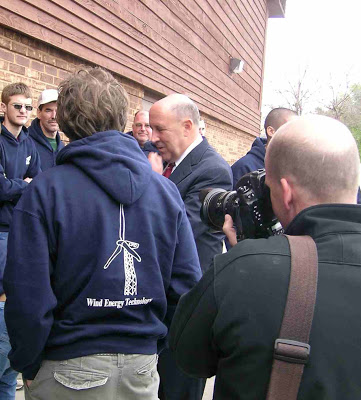
Govenor Doyle chatted during the dedication program with students from Lakeshore Technical College’s Wind Energy Technican program.
A report from Jeff Anthony of the American Wind Energy Association (AWEA):
At the first wind project dedication ceremony for a major wind project in the state of Wisconsin in over seven years, Governor Jim Doyle (D) and other state government officials dedicated the Forward Wind Center in Brownsville, WI. Governor Doyle gave remarks at the ceremony on Wednesday, October 22, 2008 at the Brownville Community Center, noting that “the project represents a clean energy milestone for Wisconsin, meaning greater energy security, better wages in green jobs, and clean air and water for generations to come”. He also emphasized that in the economic turbulence “clean energy future greater investment, more jobs, and more security at home”.
A global warming task force commissioned by Governor Doyle issued a report in August recommending that Wisconsin accelerate its Renewable Energy Standard targets, achieving 10% by 2013, 20% by 2020 and 25% by 2025. Governor Doyle also reiterated his intent to pass the enhanced RES in the 2009 legislative session to require state utilities to get 25% of their electricity from renewable energy such as the energy produced by the Forward Wind Center by the year 2015. He also called for the great manufacturing capabilities in Wisconsin to be directed towards clean energy technologies such as wind power as well.
Michael Polsky, President and CEO of Invenergy, welcomed an over-flowing crowd to the project dedication ceremony and described the benefits of wind power, saying “It just makes sense” from so many different perspectives, including energy security, long-term clean energy production, and environmental benefits. Tours were conducted throughout the afternoon by developer Invenergy, the project owner and operator. The output of the project is under contract to four Wisconsin utilizes: Madison Gas & Electric, Wisconsin Public Service, Wisconsin Power & Light (Alliant Energy), and Wisconsin Public Power, Inc. The Forward Wind Center consists of 86 General Electric 1.5 MW wind turbines (for a total of 129 MW) covering 12,000 acres in Dodge and Fond du Lac counties in Southeastern Wisconsin. Commercial operations at the facility began in March 2008, the project is expected to produce enough energy to power 30,000 homes and avoid the burning of 187 million pounds of coal per year. The Forward wind project is one of four major wind projects schedule to come on-line in 2008, representing a major step forward for the state of Wisconsin.
More from an article by Aubrey Fleischer in The Reporter (Fond du Lac).