The unfolding situation in Texas remains dire. The grid operator, the Electric Reliability Council of Texas (ERCOT) first warned of rolling blackouts on Sunday, February 14, 2021. The blackouts and widespread power outages lasted for days in the Lone Star state amidst some of the harshest winter weather in years. Millions of people were left without power and dozens perished.
Now just ten days out from the onset of the crisis, water contamination and shortages (resulting from frozen and broken pipes) continue to threaten the health and welfare of Texas residents.
Immediately preceding the energy crisis, a powerful winter storm blanketed the southern Plains with freezing rain and snow, followed by record low temperatures. Frigid temperatures had a stranglehold on the central U.S. for two straight weeks, extending from Canada to Mexico. Many parts of Texas and the South rely on electricity as their primary source of heat, as opposed to gas, propane, or wood, which are more commonly used in the northern United States. The prolonged cold snap created a high demand for natural gas, for both heating and electricity generation around the region, triggering an upsurge in electricity consumption.
Everything that could go wrong, did go wrong
As demand skyrocketed, supply plummeted. Even before the winter weather moved in ERCOT had nearly 14 gigawatts (GW) of electric-generating capacity offline for maintenance. As other generating sources were shuttered, ERCOT was left with as much as 34 GWs of electric production offline. This periodically amounted to 30-42% of ERCOT’s total electric capacity.
Unfortunately, the outages gave rise to a disinformation campaign that attempted to implicate frozen wind turbines as the principal cause of the power outages. This narrative is patently false. While some wind turbines were frozen and unable to produce electricity, the cold and ice had a far more disruptive effect on thermal plants.
Wind, natural gas, and other energy sources need to be weatherized
In fact, renewable energy generation facilities played a key role in keeping the lights on. According to ERCOT, wind power output exceeded forecasted generation numbers during the blackouts, even with the icing of turbines. At times, solar generation has also exceeded output. Wind turbines would have done better if they had used heating technology as Sweden does, to prevent icing and keep turbines generating power in extreme cold. Using heating carbon-fiber technology similar to aircraft, Swedish maintenance workers add a thin layer of material to the wings of the turbines that can be automatically heated can prevent ice before it forms.
The bottom line is that our electricity grid and all types of power generation are vulnerable to extreme weather events. We need to plan for these events and invest in grid resilience and weatherization to prevent disasters like this from repeating.
There is no single cause for the situation currently unfolding in Texas, and no silver bullet for preventing a repeat situation. A combination of record demand due to the prolonged cold temperatures, and generators not equipped to function in very cold temperatures are responsible for the rolling blackouts now plaguing the state.
Planning and preparing for extreme weather has to be part of the conversation
Renewables are reliable sources of energy from Texas to Antarctica. Even during extreme weather events, wind and solar can function when traditional energy sources have gone offline. More renewable energy sources, in more locations, will diversify our grid and make it less susceptible to the forces of nature and the market. Microgrids and energy storage are important tools to help shore up the reliability and safety of our grid.
Extreme weather events will continue to complicate our lives and strain our power grids over the foreseeable future. By incorporating more sources of renewable energy, we can reduce problems and increase reliability in our electric grid.
3.11.2021 Update: After the initial posting of this blog, further research indicates that the Darien Solar Energy Center would have a *capacity factor likely closer to 0.24, not .30. Using this updated capacity factor of .24 for the Darien Solar Energy Center, emissions would decrease by 423,000 tons of carbon dioxide (CO2), 602,000 pounds of nitrogen oxides (NOx), 745,000 pounds of sulfur dioxide (SO2), and 76,000 pounds of particulate matter (PM10) annually for the lifetime of the project. These emissions reductions would lead to decreased mortality of about one life per year, annual health savings between $15 to $34 million, and yearly climate savings of over $17 million
* Capacity factor expresses in percentage form the expected production of a power plant relative to its maximum possible output. This ratio takes into account variables such as maintenance-related downtime and the availability of the energy source fueling the plant. All power plants have a capacity factor of less than one.
Consider a solar farm sized to produce a theoretical maximum of 10,000 megawatt-hours/year. If the plant is estimated to have a capacity factor of 0.30, it can be expected to produce 3,000 megawatt-hours a year. A solar farm could not have a 1.0 capacity factor because the sun doesn’t shine all day. In fact, with nighttime constituting half of the hours in a year, a solar farm could not have a capacity factor greater than 0.50.
The Darien Solar Energy Center is a proposed 250-MW solar PV facility in Walworth county, Wisconsin currently under review at the Wisconsin Public Service Commission. If approved, developers hope to have the project constructed and energized by 2023, offering significant health, environmental, and economic benefits to local Wisconsin communities.
Using the EPA’s Avoided Emission and Generation tool, RENEW Wisconsin estimates that the Darien Solar Energy Center could reduce emissions by 538 thousand tons of carbon dioxide (CO2), 700 thousand pounds of nitrogen oxides (NOx), 1 million pounds of sulfur dioxide (SO2), and 98 thousand pounds of particulate matter (PM10) annually for the lifetime of the project. Carbon dioxide is a greenhouse gas that contributes to climate change, and sulfur dioxide, nitrogen oxides, and particulate matter contribute to health problems including asthma, cardiopulmonary disease, and premature mortality. Fossil fuel power plants are the primary emission sources of these pollutants. Transitioning to the clean energy produced by the Darien solar project, Wisconsin would reduce its fossil fuel generation, providing significant human health and environmental benefits to its residents.
RENEW Wisconsin completed in-house research on the health benefits of the Darien project. Using the EPA’s Co-Benefit Risk Assessment model, the Darien Solar Energy Center is estimated to reduce mortality by up to one life per year for 30 years in Wisconsin. The health impacts are substantial for Wisconsin, a state highly dependent on coal-fired electricity generation. Energizing the Darien Solar Energy Center could directly save Wisconsin lives.
In addition to the health benefits of clean energy, there are also significant economic benefits this solar project could deliver. Using the EPA’s health benefit factors for Wisconsin, the annual savings ranged from $18 to $42 million depending on population, pollution burden, and other differentiating factors. Moreover, Darien could produce up to $22 million in annual savings resulting from avoided climate impacts. Climate impacts are estimated from the EPA’s social cost of carbon values. These monetized health impacts are significant and illustrate the benefits that the Darien Solar Energy Center could bring to the Wisconsin economy.
Overall, these findings detail the benefits that the Darien Solar Energy Center offers Wisconsin by reducing pollution, decreasing human mortality, helping to mitigate climate damages, and providing millions of dollars in economic benefits to the state. Other significant benefits related to Wisconsin GDP, employment, and environmental and water impacts were not discussed in this article. To learn more about the Darien Solar Energy Center and its additional benefits, please visit the Town of Darien website.
Wisconsin’s distributed generation (DG) renewable energy market lags behind comparable states.[1] As seen in other states, DG helps diverse groups of individuals and organizations, including businesses, residents, renewable energy customers, and future renewable energy customers, gain access to renewable energy and create a more fair and navigable market.
Whether it takes the form of behind-the-meter generators powering individual customers or larger projects feeding power directly into the distribution grid, DG is a vitally important segment of the renewable energy landscape. Customer investments drive these installations with benefits extending to Wisconsin businesses, residences, governments, nonprofits, and their communities. DG clean energy investments help spur local economic investment, support clean energy jobs, and save Wisconsin money that otherwise would have been spent on importing fossil fuels.
It has long been RENEW’s view that a more fair, clear, and consistent regulatory environment could strengthen the DG market and accelerate the transition to renewable energy in Wisconsin.
In June 2020 the Public Service Commission of Wisconsin (PSC) convened an investigative docket” (5-EI-157) to identify regulatory barriers that effectively put a tight lid on Wisconsin’s DG market, especially customer-sited DG.
This investigation is structured to encourage input and recommendations from organizations and entities that support small-scale DG. RENEW has assembled an expert legal and technical team for this docket—Tim Lindl and Melissa Birchard of Keyes and Fox, and Justin Barnes of EQ Research. We invite you to review the legal and policy analysis we provided to the PSC in August 2020 and in January 2021.[2] A coalition of organizations (Clean Energy Advocates) joined our comments to the PSC, demonstrating broad support for an improved DG market. This ongoing investigation is the best opportunity we’ve had in more than 10 years to advance renewably powered DG before the PSC.
The success of this campaign will strengthen and expand the renewable DG market in Wisconsin. If you support this work, please consider a donation to RENEW today. Together we can champion renewable energy growth in Wisconsin and we are poised to make significant progress in 2021. Join us today!
Wisconsin has fewer net metering customers than comparable states
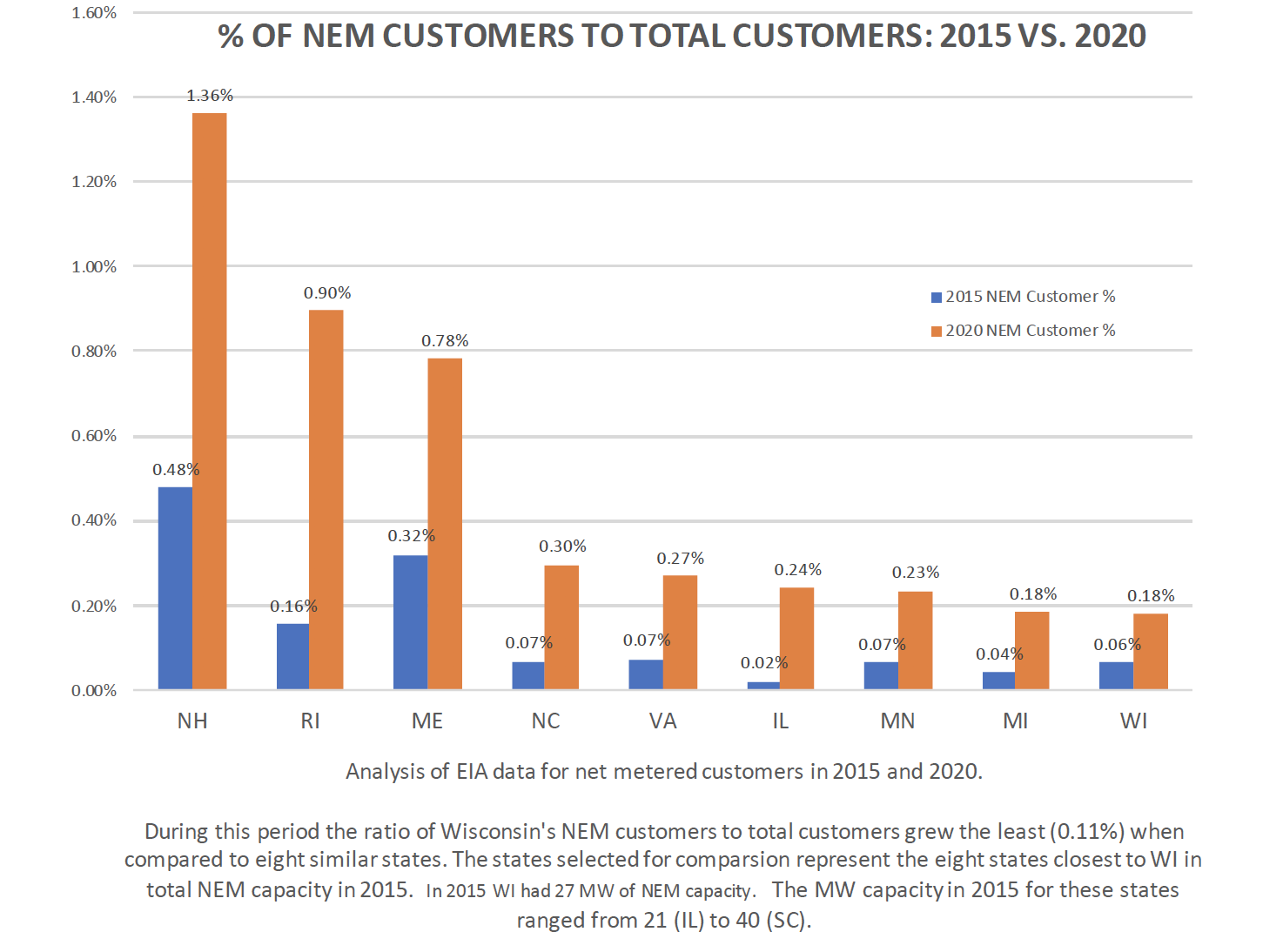
Net metering customers represent an important segment of the renewable energy market, however, Wisconsin is falling behind. In the last four years, net metered customers in Wisconsin have grown by only 0.11%, well below the increases seen elsewhere in other states since 2015.
Fair and clear distributed generation policies would grow the renewable energy market in Wisconsin
RENEW Wisconsin aims to enlarge the market share for non-utility-owned renewable DG, including both self-supply and grid-supply projects. In furtherance of that goal, we’ve developed a number of principles that should inform decisions rendered in the DG docket. These include:
Ensuring developer access to standard offer contracts that have terms for reasonable compensation.
Giving developers insight into system and utility resource needs to help them target their planned investments.
Provide larger energy users with better and less restrictive opportunities for larger self-supply resources.
Standardize and improve net metering rates for all customers across Investor-owned Utilities (IOUs).
In addition to behind-the-meter systems, RENEW has also set forth a path for front-of-meter renewable generation projects up to 20MW. These types of projects should be eligible for 20-year standard offer contracts that are pegged to the same methodologies that utilities use when assigning value to their own generation projects. Leveling the playing field for compensating solar is essential to increasing customer investment opportunities, and expanding the solar workforce.
RENEW is optimistic that by the end of the docket the PSC will land on several beneficial policy changes for promoting renewable DG. These policy changes could be taken up later this year through the anticipated utility rate case filings. Should events unfold along these lines, solar developers and customers stand ready to benefit from a more fair, clear, and consistent renewable energy market.
Join RENEW’s campaign to advance renewable distributed generation in Wisconsin
Since 1991, RENEW has been the state’s preeminent advocate for renewable energy. At the macro scale, solar and wind can outcompete fossil fuels on cost and environmental performance. For the first time in more than a decade, we have an opportunity in Wisconsin to broaden the clean energy transition underway to benefit all customers who place a value in a healthy energy economy. A clear, fair and forward-looking regulatory environment will be crucial to spreading renewable energy across all sectors of society. RENEW is bringing together the leadership and expertise necessary to undo the regulatory barriers that have held renewable DG back, and to replace them with policies to make renewable DG more accessible, affordable, and plentiful across Wisconsin. We hope you will join us in this work by donating today. 2021 promises to be an exciting year!
[1] RENEW evaluated eight states closest to Wisconsin in terms of cumulative Net Energy Metering (NEM) capacity at the end of 2015, i.e., the four states immediately above and below Wisconsin in EIA data listing NEM capacity by state. The eight states closest to WI in NEM capacity in 2015 included NH, RI, ME, NC, VA, IL, MN, and MI. The 2020 data is based on NEM capacity through April 2020. The percentage of total customers uses 2018 total state customer counts for both calculations. Note that Wisconsin has fallen behind states it had previously led. See bar graph for more information.
[2] In the most recent comments filed by Clean Energy Advocates, we looked at this year’s PSC calendar to assess how our recommended actions can make their way into regulatory policy. The DG docket now underway is well-timed in that we expect every Class A investor-owned utility in Wisconsin to file for new rates in 2021.
At its first open meeting of 2021, the Public Service Commission (PSC) cleared the path for Wisconsin’s next solar farm, a 150 megawatt (MW) project near Wisconsin Rapids in Wood County, to proceed to construction. Developed by Savion Energy, the Wood County Solar Farm is one of six Wisconsin solar farms totaling 675 MW that Alliant Energy-Wisconsin Power and Light seeks to acquire for its own generating fleet.
Wood County is the sixth solar farm proposal to be granted a siting permit from the PSC since April 2019, when the agency approved Wisconsin’s first two solar farms, Two Creeks and Badger Hollow. With the authorization of the Wood County project, total solar power capacity approved by the PSC climbed above one gigawatt (see Table 1).
With this favorable ruling, four of the six solar farms that Alliant Energy plans to acquire now have permits. In addition to Wood County, the other permitted solar farms are Crawfish River, a 75 MW project near Jefferson, North Rock, a 50 MW project near Edgerton, and Richland County Solar, a 50 MW project near Lone Rock, also developed by Savion Energy (see Table 2).
Two other proposed solar farms—the 200 MW Grant County project near Potosi and the 150 MW Onion River project near Oostburg in Sheboygan County–are moving through the regulatory review process. The PSC is expected to issue rulings on those two projects, along with Alliant’s application to own and operate all six solar farms, over the next three months.
Presently, the site is mostly a red pine plantation grown for the pulp and paper industry. Following PSCW approval of Wood County Solar Project, the work to harvest the site’s existing stand of trees will begin. Coordination has already commenced between the Project, Alliant Energy, The Town of Saratoga, and Wood County to ensure an orderly harvesting campaign.
Though the parcel has been a working tree farm since 1938, development pressure has been intensifying in recent years. In 2012, the Wysocki Family of Companies applied for permits to establish a 3,500-cow dairy operation on that property, and over time the proposal grew to approximately 5,300 cows. The residents of the Town of Saratoga fought the dairy proposal vehemently, in part to protect drinking water wells that supply many of the local families. The solar farm has received wide support in the community.
The construction timetable calls for the completion of the solar farm in the fourth quarter of 2022.
Table 1: PSC-approved solar power projects since 2019
Project name
Capacity
(in MW)
Applicant
County
Two Creeks
150
NextEra Energy
Manitowoc
Badger Hollow
300
Invenergy
Iowa
Point Beach Solar
100
NextEra Energy
Manitowoc
Badger State Solar
149
Ranger Power
Jefferson
Paris Solar
200
Invenergy
Kenosha
Wood County
150
Savion
Wood
Total
1,049
Table 2: Solar power projects proposed for Alliant-WPL’s generation portfolio (Docket No. 6680-CE-182)
As part of its tenth annual Renewable Energy Summit, RENEW Wisconsin will recognize individuals and organizations who have made significant and lasting advances in renewable energy development here in Wisconsin.
Titled “Building the Clean Energy Mosaic,” this year’s Summit will be hosted virtually over three days from Tuesday, January 12th through Thursday, January 14th, 2021. The theme of this year’s event, “Building the Clean Energy Mosaic,” will highlight the diversity of technologies, people, and scale needed to shape our clean energy future.
Roster of 2020 awardees
Renewable Energy Business of the Year
Northwind Solar Cooperative, Amherst
Renewable Energy Catalysts of the Year:
Sid Sczygelski & Ali Wolf, Aspirus Health, Wausau
Charles Hua, Madison
Renewable Energy Champion of the Year
Oregon School District
Renewable Energy Pioneer of the Year
Dane County
Renewable Energy Project of the Year
Two Creeks Solar Park, Manitowoc County
NextEra Energy Resources (developer)
Wisconsin Public Service Corp. (joint owner)
Madison Gas and Electric (joint owner)
Renewable Energy Business of the Year
NorthwindSolar Cooperative has been a fixture in Central Wisconsin’s renewable energy marketplace since 2007, operating principally in the residential and small commercial segments. Throughout its history, Northwind has been acutely conscious of the value of community ties. Northwind’s PV systems are a common sight in Amherst. The company has operated the Grow Solar – Central Wisconsin group purchase program for four straight years, designing and installing more than a megawatt of solar capacity for 168 residential customers. After the company reorganized itself as a worker-owned cooperative structure, Northwind committed to building a new headquarters building in Amherst Business Park that showcases its talents and services. With 44 kW of PV capacity and multiple battery configurations, Northwind’s new headquarters building invites prospective customers to pursue solar + storage as the energy package of the future.
Renewable Energy Catalysts of the Year
Aspirus Health is a health care organization serving much of central and northern Wisconsin and Michigan’s Upper Peninsula, with 10 hospitals, 50+ clinics, labs and other service-providing facilities within its system. In 2018 Aspirus launched a systemwide initiative to identify and implement strategies for slashing its energy overhead and scaling back its carbon footprint. Sid Sczygelski, chief financial officer of Aspirus, chairs this initiative, while Sustainability Director Ali Wolf directs and coordinates this ambitious undertaking. Their goal is to reduce carbon emissions systemwide 80% by 2030. Going into 2021, Sczygelski, Wolf and the Aspirus sustainability team have made great progress to date. Aspirus has integrated into its buildings more than 900 kilowatts of solar PV on its rooftops, saving more than $600,000/year in energy expenses. In 2021, Aspirus plans to double its use of solar energy systemwide and complete construction on its most energy-efficient facility yet, a clinic in Wausau.
In 2017, students and staff at Madison West High School started work on a campaign to power their school with a rooftop solar PV system. That year, Charles Hua, then a junior, took the helm of West Green Club and launched a fundraising and outreach campaign that blossomed into one of the largest youth-led sustainability efforts in Wisconsin. From June 2017 through 2019, the West Green Club raised nearly $90,000 from staff, students, parents and local foundations, accounting for nearly 50% of the cost of their 128 kW solar PV system. Installed last summer by Westphal Electric, Madison West’s solar system is now the largest array supplying electricity to a Madison Metropolitan School District building. The example set by Hua and West Green Club helped inspire the school district to adopt a 100% renewable goal for all of its facilities. Hua is now a junior at Harvard University.
Renewable Energy Champion of the Year
Long a leader in pursuing solar power for its operations, Oregon School District took advantage of an opportunity in 2018 to push the envelope on sustainability at its new Forest Edge Elementary School in Fitchburg. Collaborating with HGA’s Madison office, an architectural and engineering design firm, the school district financed and saw to completion the first net zero energy public school in Wisconsin. Equipped with a 646 kW rooftop solar array, a ground-source heat pump system and onsite battery storage, Forest Edge is an all-electric building. There is no gas connection to the school. Completed in the fall of 2020, Forest Edge represents a quantum leap in capturing, controlling and maximizing the economic value of sunshine and ground temperatures to heat, cool and power a building where many people congregate.
Renewable Energy Pioneer of the Year
Impatient with federal and state government inaction on climate change, Dane County decided to roll up it sleeves and get to work, starting in 2017 with the creation of the Office of Climate Change and Energy. The County’s approach to reducing fossil fuel use has been aggressive and remarkably systematic for a local government. A number of these actions bore fruit in 2020. These include:
Throwing the switch on a biogas processing plant in April that converts gas from landfill waste and cow manure into a pipeline-grade renewable fuel;
Releasing a Climate Action Plan, also in April, containing recommendations for reducing greenhouse gas emissions countywide 45% by 2030 and achieving net zero emissions by 2050;
Partnering with Madison Gas and Electric to host a 9-megawatt solar array on airport property and purchase the output from that project, under a long-term contract; and
Purchasing property in the Town of Cottage Grove to host a larger solar array that will enable the County to offset all of its electricity usage with zero-emission power.
Renewable Energy Project of the Year
Developed by Florida-based NextEra Energy Resources in Manitowoc County, the 150-megawatt Two Creeks Solar Park was energized last November. It is now the largest power plant in the state of Wisconsin that is fueled by the sun. Jointly owned by Wisconsin Public Service and Madison Gas and Electric, Two Creeks effectively doubled solar generation capacity in Wisconsin, and its output will equal the electrical consumption of 33,000 residential households. Two Creeks was the first solar power plant to receive approval from the Public Service Commission, and the first to be approved as a utility-owned asset. Seeing Two Creeks to completion opens the door to a new chapter in electric power, one highlighted by the emergence of solar power as the cleanest, more affordable and least risky supply option available to Wisconsin electric providers.
This year’s summit program will also draw attention to other milestones and notable achievements in 2020, including the following:
The Public Service Commission approved two large solar farms—Badger State Solar and Paris Solar—that will add 349 MW of solar power to Wisconsin’s electric generation portfolio;
Madison Gas and Electric completed two smaller solar farms in its service territory, with a combined capacity of 14 MW, to supply several customers under contract and expand its shared solar program;
Grants from RENEW’s Solar for Good program resulted in 27 new solar installations across the state totaling 1,265 kW of operating capacity.
Two Eau Claire high schools—Memorial and North—celebrated the completion of their 126 kW solar arrays supported by Solar on Schools, a joint venture between the Couillard Solar Foundation and the Midwest Renewable Energy Association.
Eagle Point Solar installed 400 kW(AC) of PV capacity, serving four City of La Crosse-owned buildings.
On Sunday December 27th, President Trump signed a $1.4 trillion omnibus spending bill that includes support for clean energy programs and the extension of two important renewable energy tax credits. The law provides support for the advancement of solar, wind, energy storage, research and development, and energy efficiency.
The renewable electricity Production Tax Credit (PTC) and the Investment Tax Credit (ITC) have been instrumental to advancing renewable energy in the United States and the extension included in the recent omnibus bill will help ensure clean energy’s continued growth. The tax credits for wind and solar, in particular, are expected to spur vital economic investment.
Abby Hopper, President and CEO of the Solar Energy Industry Association (SEIA), sent a summary of key solar and energy storage provisions to local SEIA Chapters like RENEW Wisconsin. Below are highlights from her report:
Federal Tax Bill 2020 – Key Solar And Storage Provisions
Federal Tax Credits Extended: The solar investment tax credit (ITC) will remain at 26% for projects that begin construction in 2021 and 2022, step down to 22% in 2023, and down to 10% in 2024 for commercial projects while the residential credit ends completely. Companies beginning construction on projects in 2021 will still have a four-year period to place their projects in service to take advantage of the ITC, with the statutory deadline for projects placed in service reset to before January 1, 2026.
Reduce Barriers to Solar Adoption: $35 million appropriation for the Department of Energy (DOE), directing the Solar Energy Technologies Office to “reduce market barriers…to the adoption of solar energy technologies,” including “the development of best practices, models, and voluntary streamlined processes for local siting and permitting of distributed solar energy systems to reduce costs.”
Increase Funding for Solar Research: Boosts annual spending targets to $300 million per year through 2025 for DOE programs that improve solar PV energy efficiency and cost-effectiveness, increase manufacturing and recycling of solar panels, and fund programs to integrate solar power into the grid;
Invest in Energy Storage Research: Directs $100 million per year through 2025 to a newly created Energy Storage System Research, Development, and Deployment Program at DOE, aimed at R&D to improve technologies ranging from distributed batteries and control systems for grid integration, long-duration storage technologies such as pumped hydro and compressed-air energy storage.
RENEW Wisconsin is thrilled to see this package come together and get signed into law. This new investment in clean energy is welcome news for Wisconsin’s renewable energy workers and has the potential to drive economic activity and clean energy investment in the coming years.