by jboullion | Jul 8, 2010 | Uncategorized
From a news release issued by RENEW Wisconsin:
Collectively drawing upon the individual roadblocks that developers experienced in permitting wind energy projects in Wisconsin, a group of renewable energy stakeholders urged the Public Service Commission to adopt standards that can’t be undermined by additional restrictions imposed by local governments.
The comments, submitted on behalf of 38 signatories, addressed the draft siting rule published by the Commission in mid-May. The draft rule proposed standards applicable to all wind energy systems — large and small — erected in Wisconsin. In the next phase of this proceeding, the Commission will review the public comments before issuing a final rule in August.
The rule will specify, among other things, setback distances from neighbors, sound limits, shadow flicker durations, procedures for decommissioning inoperable turbines, and mitigating electronic signal interference.
Noting that local governments would have discretionary authority going beyond the legislation’s intentions, renewable energy supporters recommended specific changes to give developers a greater sense of certainty in the permitting process.
“We are willing to work collaboratively and cooperatively with political subdivisions to establish mutually agreeable provisions beyond the requirements of the rules,” the stakeholders said in their joint comments. “However, we cannot develop wind projects in Wisconsin if current uncertainty regarding political subdivision requirements continues.”
by jboullion | Jul 8, 2010 | Uncategorized
From an article by Danielle Begalke in The Country Today:
TOMAH – The story of how cranberry grower Fred Prehn came to own his first wind turbine begins in an unusual place.
His son, Fritz, a materials science major at UW-Madison, came up with the idea as the pair climbed Mount Aconcagua in South America.
“He said, ‘Dad, why don’t you do something renewable and make a statement?’ ” Prehn recalled.
That statement was made last December when Prehn had a 35-kilowatt Endurance Wind Power wind turbine installed to power his Prehn Cranberry Co. in Tomah.
The source of renewable energy stretches toward the sky on a 140-foot-tall base.
In terms of wind turbines, that’s relatively small, Prehn said. But the turbine has made a big impact.
Prehn said he had reservations about how well the turbine would work at his 160-acre Monroe County farm.
“There’s better wind in other parts of the state, no question about it,” he said.
Still, with average wind speeds of about 12.5 mph at his farm, Prehn estimated the turbine will pump out 100,000 kilowatts of energy per year – enough to run about eight homes annually. The turbine powers his shop and an employee’s home.
According to Ry Thompson, a project manager at Seventh Generation Energy in Madison, which installed the turbine, the Endurance turbine fits well in Wisconsin’s climate.
“We’ve been eager to install one of these,” Thompson said. “It’s a very well-designed, durable machine, and the 30-foot-long blades make it suitable to lower wind speed environments, as are common in Wisconsin.”
Thompson said he expects the turbine to be popular among farmers, schools and manufacturing facilities.
Prehn said he earns 11 cents for every unused kilowatt the turbine produces.
“Right now my electric bill is nothing,” he said. “Oakdale Electric is paying me.”
by jboullion | Jul 8, 2010 | Uncategorized
From a news release issued by RENEW Wisconsin:
Collectively drawing upon the individual roadblocks that developers experienced in permitting wind energy projects in Wisconsin, a group of renewable energy stakeholders urged the Public Service Commission to adopt standards that can’t be undermined by additional restrictions imposed by local governments.
The comments, submitted on behalf of 38 signatories, addressed the draft siting rule published by the Commission in mid-May. The draft rule proposed standards applicable to all wind energy systems — large and small — erected in Wisconsin. In the next phase of this proceeding, the Commission will review the public comments before issuing a final rule in August.
The rule will specify, among other things, setback distances from neighbors, sound limits, shadow flicker durations, procedures for decommissioning inoperable turbines, and mitigating electronic signal interference.
Noting that local governments would have discretionary authority going beyond the legislation’s intentions, renewable energy supporters recommended specific changes to give developers a greater sense of certainty in the permitting process.
“We are willing to work collaboratively and cooperatively with political subdivisions to establish mutually agreeable provisions beyond the requirements of the rules,” the stakeholders said in their joint comments. “However, we cannot develop wind projects in Wisconsin if current uncertainty regarding political subdivision requirements continues.”
by jboullion | Jul 8, 2010 | Uncategorized
IMMEDIATE RELEASE
July 7, 2010
MORE INFORMATION
Michael Vickerman
RENEW Wisconsin
608.255.4044
mvickerman@renewwisconsin.org
Stakeholders Cite Uniformity as Key to Wind Siting Success
Collectively drawing upon the individual roadblocks that developers experienced in permitting wind energy projects in Wisconsin, a group of renewable energy stakeholders urged the Public Service Commission to adopt standards that can’t be undermined by additional restrictions imposed by local governments.
The comments, submitted on behalf of 38 signatories, addressed the draft siting rule published by the Commission in mid-May. The draft rule proposed standards applicable to all wind energy systems — large and small — erected in Wisconsin. In the next phase of this proceeding, the Commission will review the public comments before issuing a final rule in August.
The rule will specify, among other things, setback distances from neighbors, sound limits, shadow flicker durations, procedures for decommissioning inoperable turbines, and mitigating electronic signal interference.
Noting that local governments would have discretionary authority going beyond the legislation’s intentions, renewable energy supporters recommended specific changes to give developers a greater sense of certainty in the permitting process.
“We are willing to work collaboratively and cooperatively with political subdivisions to establish mutually agreeable provisions beyond the requirements of the rules,” the stakeholders said in their joint comments. “However, we cannot develop wind projects in Wisconsin if current uncertainty regarding political subdivision requirements continues.”
“Many worthy projects have been stalled by changes made to ordinances after the project application was filed,” said Michael Vickerman, Executive Director of RENEW Wisconsin, a
renewable energy advocacy organization and a signatory to the joint comments. “We have to ensure that the rules don’t create opportunities for new restrictions that could bring wind energy development to a standstill.”
One example of such a restriction would be a requirement on developers to guarantee property values in the project area, Vickerman said. “Those kinds of conditions have nothing to do with protecting public health and safety, but would certainly increase wind development costs. Their real purpose would be to make wind energy an economic non-starter in whichever community that adopts those requirements.”
The comments submitted on behalf of renewable energy stakeholders can be retrieved at this link — http://psc.wi.gov/apps35/ERF_view/viewdoc.aspx?docid=134452
END
RENEW Wisconsin (http://www.renewwisconsin.org/) is an independent, nonprofit 501(c)(3) organization that acts as a catalyst to advance a sustainable energy future through public policy and private sector initiatives.
by jboullion | Jul 7, 2010 | Uncategorized
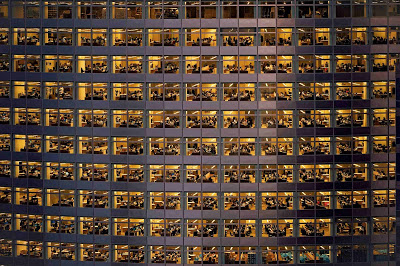
As daylight fades, Manhattan continues to gorge on power. New York City is tied to fuels like natural gas, with less than one percent of its electricity coming from wind or solar.
From an article by Joel Achenbach in National Geographic, with photos by Joe McNally
Can we fix the infrastructure that powers our lives?
We are creatures of the grid. We are embedded in it and empowered by it. The sun used to govern our lives, but now, thanks to the grid, darkness falls at our convenience. During the Depression, when power lines first electrified rural America, a farmer in Tennessee rose in church one Sunday and said—power companies love this story—”The greatest thing on earth is to have the love of God in your heart, and the next greatest thing is to have electricity in your house.” He was talking about a few lightbulbs and maybe a radio. He had no idea.
Juice from the grid now penetrates every corner of our lives, and we pay no more attention to it than to the oxygen in the air. Until something goes wrong, that is, and we’re suddenly in the dark, fumbling for flashlights and candles, worrying about the frozen food in what used to be called (in pre-grid days) the icebox. Or until the batteries run dry in our laptops or smart phones, and we find ourselves scouring the dusty corners of airports for an outlet, desperate for the magical power of electrons.
The grid is wondrous. And yet—in part because we’ve paid so little attention to it, engineers tell us—it’s not the grid we need for the 21st century. It’s too old. It’s reliable but not reliable enough, especially in the United States, especially for our mushrooming population of finicky digital devices. Blackouts, brownouts, and other power outs cost Americans an estimated $80 billion a year. And at the same time that it needs to become more reliable, the grid needs dramatic upgrading to handle a different kind of power, a greener kind. That means, among other things, more transmission lines to carry wind power and solar power from remote places to big cities.
Most important, the grid must get smarter. . . .
by jboullion | Jul 7, 2010 | Uncategorized
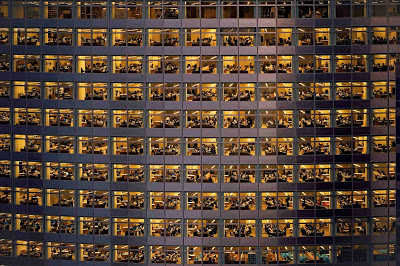
As daylight fades, Manhattan continues to gorge on power. New York City is tied to fuels like natural gas, with less than one percent of its electricity coming from wind or solar.
From an article by Joel Achenbach in National Geographic, with photos by Joe McNally
Can we fix the infrastructure that powers our lives?
We are creatures of the grid. We are embedded in it and empowered by it. The sun used to govern our lives, but now, thanks to the grid, darkness falls at our convenience. During the Depression, when power lines first electrified rural America, a farmer in Tennessee rose in church one Sunday and said—power companies love this story—”The greatest thing on earth is to have the love of God in your heart, and the next greatest thing is to have electricity in your house.” He was talking about a few lightbulbs and maybe a radio. He had no idea.
Juice from the grid now penetrates every corner of our lives, and we pay no more attention to it than to the oxygen in the air. Until something goes wrong, that is, and we’re suddenly in the dark, fumbling for flashlights and candles, worrying about the frozen food in what used to be called (in pre-grid days) the icebox. Or until the batteries run dry in our laptops or smart phones, and we find ourselves scouring the dusty corners of airports for an outlet, desperate for the magical power of electrons.
The grid is wondrous. And yet—in part because we’ve paid so little attention to it, engineers tell us—it’s not the grid we need for the 21st century. It’s too old. It’s reliable but not reliable enough, especially in the United States, especially for our mushrooming population of finicky digital devices. Blackouts, brownouts, and other power outs cost Americans an estimated $80 billion a year. And at the same time that it needs to become more reliable, the grid needs dramatic upgrading to handle a different kind of power, a greener kind. That means, among other things, more transmission lines to carry wind power and solar power from remote places to big cities.
Most important, the grid must get smarter. . . .
by jboullion | Jul 6, 2010 | Uncategorized
From an article by Dustin Kass of the Winona (MN) Daily News:
WINONA, Minn. – Funding for a high-speed rail line in Minnesota is in jeopardy after federal delays have put the project months behind schedule.
A route for high-speed rail service between Madison and the Twin Cities likely will not be selected until this winter, nearly half a year after originally estimated, Minnesota Department of Transportation officials say. The delay could torpedo the chances of the project receiving federal funding – and of cities such as La Crosse or Winona gaining the economic boost the service would bring.
“The longer we delay, in my view, the less chance you get any money,” Winona Mayor Jerry Miller said.
MnDOT received a $600,000 federal planning grant in January to cover half the cost of a preliminary study examining possible routes between Madison and the Twin Cities. But officials have not even started the study because they are waiting on Federal Railroad Administration officials to review the results of a separate Midwest regional study completed in 2004, said Dan Krom, director of the MnDOT office of Passenger Rail.
Officials are considering lines that would run through Eau Claire or La Crosse, with the second route passing through either Winona or Rochester, Minn. Winona leaders have banded with representatives from municipalities along the Mississippi River to form the Minnesota High-Speed Rail Commission and advocate for the line to follow an existing train route along the river. Miller is the commission’s chairman.
Krom attributed the FRA delays to the burden the agency faces as it administers $8 billion in high-speed rail projects awarded in January. FRA officials did not respond to a call for comment on this story.
The Madison-to-Twin Cities study now will likely start in September, Krom said, with a
preferred route indicated “by the end of they year.” The full study isn’t expected to be finished until September 2011.
by jboullion | Jul 6, 2010 | Uncategorized
From a news release issued by the Citizens Utility Board (CUB):
MADISON – The Citizens Utility Board filed a lawsuit on Friday, July 2 against the Public Service Commission for its decision to allow Wisconsin Power & Light to give discounts to industrial customers that will likely be subsidized by residential customers and others.
Wisconsin Power and Light, a utility subsidiary of Alliant Energy, applied with the PSC on November 13, 2009 for permission to offer an “economic development rate” that would provide certain large industrial customers with discounts on electricity service. The PSC issued an order approving this rate on June 4, 2010.
CUB has long been opposed to rates with discounts, because they usually force other customers to pay for the discount. The laws that regulate utility service in Wisconsin prohibit utilities from charging rates that provide discounts to one customer that are subsidized by other customers. CUB noted many of these concerns in correspondence to the PSC dated February 17 and March 16, 2010, and in its lawsuit filed last Friday.
Although PSC Chairperson Eric Callisto and Commissioner Mark Meyer approved the discounted rates, Commissioner Lauren Azar voted against them, noting that subsidies for certain industrial customers may cause higher rates for residential and commercial customers. Ms. Azar also issued a dissenting opinion on June 25, 2010, in which she called the rate “essentially a giveaway to businesses.”
“CUB filed this lawsuit to protect residential customers from subsidizing large, politically powerful companies,” said CUB executive director Charlie Higley. “The job of the PSC is to set electric rates that are fair, just, and reasonable, and the economic development rate approved by the PSC violates these legal principles.”
by jboullion | Jul 6, 2010 | Uncategorized
From an article by Larry Sandler of the Milwaukee Journal Sentinel:
But expansion of I-94 finds increased support
Support for new rail transit systems has dipped below 50% in the Milwaukee area, while I-94 expansion receives stronger backing but still falls just short of a majority, according to a recent poll.
At the same time, The People Speak Poll found majority support throughout the four-county area for a new half-cent sales tax in Milwaukee County only to fund the county’s transit system, despite skepticism about empowering a regional transit authority to levy a broader sales tax.
The Public Policy Forum’s People Speak Poll is a tracking poll, designed to follow changes in public opinion on key local issues over time. The latest telephone poll of 386 residents in Milwaukee, Waukesha, Ozaukee and Washington counties focused on transportation issues and was the third such poll in a year to ask about plans for high-speed trains, commuter rail and streetcars.
Last fall, 57% backed plans for high-speed trains linking Milwaukee to Madison and Chicago. Narrower majorities supported plans for commuter trains from Milwaukee to Kenosha and Racine and modern streetcars in downtown Milwaukee. Those results didn’t change much in the spring.
But when the latest poll was conducted June 1-4, support had dropped to 41% for high-speed rail and 42% each for downtown streetcars and commuter rail, the Public Policy Forum reported.
By contrast, a new question about adding lanes to I-94 between Milwaukee and Waukesha drew 49% in favor to 39% opposed, with the rest voicing no opinion.
Those results reflect inroads by vocal rail transit opponents, as well as public concern about the economy and strained government budgets, Public Policy Forum President Rob Henken said.
by jboullion | Jul 6, 2010 | Uncategorized
From an article by Molly Newman in the Marshfield News-Herald:
A report released Friday [July 2] by Energy Center of Wisconsin showed Marshfield is already set to complete 93 percent of its goal as one of 10 pilot programs in Wisconsin’s “25×25” challenge.
The 25×25 plan was proposed in 2009 as a way for the state to attain its goal of generating 25 percent of energy consumption from renewable sources by 2025.
Marty Anderson, chair of the city’s Sustainable Marshfield committee, said the group came up with 16 projects to reduce energy consumption. These included solar collection and geothermal energy use in city buildings, conversion of the non-emergency fleet to hybrid vehicles and purchasing 25 percent renewable electricity from Marshfield Utilities.
“We tried to put in (the plan) projects that we thought had a reasonable likelihood of being completed,” Anderson said.
About 30 percent of the energy consumption goal will be met by projects that have already been implemented or are included on the city’s five-year plan, Anderson said. For example, the new fire station integrated several energy-efficient features.
According to Sean Weitner, author of the Energy Center report, Marshfield also proposed installation of a $12 million, 38 megawatt wind farm, a project that was not included in the 93 percent indicator because it would cost more than five times the current total energy budget.