by jboullion | Jul 2, 2010 | Uncategorized
From a news release issued by Governor Jim Doyle on the success of the ten communities in Energy Independent (EI) Pilot — Brown County; Chequamegon Bay (including the cities of Ashland, Bayfield and Washburn, the towns of Bayfield and La Pointe, the counties of Ashland and Bayfield, the Red Cliff tribe and the Bay Area Regional Transit authority); Columbus; Evansville; Fairfield; Marshfield; Oconomowoc; Osceola, including the school district; Platteville and Lancaster; Spring Green, including the school district:
MADISON – Governor Jim Doyle today announced ten Energy Independent (EI) Pilot Communities are well on their way toward achieving “25 x 25” – getting 25 percent of their electricity and 25 percent of their transportation fuels from renewable sources by 2025.
“Through the EI Pilot program communities have found ways to reduce their overall 2025 fossil fuel-based energy consumption by 30 percent,” said Governor Doyle. “This is significant considering we spend $16 billion on fossil fuel energy every year in Wisconsin, and all those dollars go outside of our state. We are finding ways to reduce our dependence
and generate jobs in Wisconsin.”
Two independent reports released by the Office of Energy Independence revealed how the ten EI Pilot Communities were able to accomplish 98 percent of their collective 25 x 25 goal.
The communities reduced their overall 2025 fossil fuel-based energy consumption by 30 percent and reduced their 2025 carbon dioxide emissions by 40 percent.
The information gathered by the EI Pilot Communities will assist Wisconsin local units of government including the 140 EI Communities to decide which strategies will work best with their unique assets and capitalize on the diversity of their resources.
The reports were conducted by two non-partisan research and policy organizations: the Local Government Institute and the Energy Center of Wisconsin.
by jboullion | Jul 2, 2010 | Uncategorized
From a news release issued by Governor Jim Doyle on the success of the ten communities in Energy Independent (EI) Pilot — Brown County; Chequamegon Bay (including the cities of Ashland, Bayfield and Washburn, the towns of Bayfield and La Pointe, the counties of Ashland and Bayfield, the Red Cliff tribe and the Bay Area Regional Transit authority); Columbus; Evansville; Fairfield; Marshfield; Oconomowoc; Osceola, including the school district; Platteville and Lancaster; Spring Green, including the school district:
MADISON – Governor Jim Doyle today announced ten Energy Independent (EI) Pilot Communities are well on their way toward achieving “25 x 25” – getting 25 percent of their electricity and 25 percent of their transportation fuels from renewable sources by 2025.
“Through the EI Pilot program communities have found ways to reduce their overall 2025 fossil fuel-based energy consumption by 30 percent,” said Governor Doyle. “This is significant considering we spend $16 billion on fossil fuel energy every year in Wisconsin, and all those dollars go outside of our state. We are finding ways to reduce our dependence
and generate jobs in Wisconsin.”
Two independent reports released by the Office of Energy Independence revealed how the ten EI Pilot Communities were able to accomplish 98 percent of their collective 25 x 25 goal.
The communities reduced their overall 2025 fossil fuel-based energy consumption by 30 percent and reduced their 2025 carbon dioxide emissions by 40 percent.
The information gathered by the EI Pilot Communities will assist Wisconsin local units of government including the 140 EI Communities to decide which strategies will work best with their unique assets and capitalize on the diversity of their resources.
The reports were conducted by two non-partisan research and policy organizations: the Local Government Institute and the Energy Center of Wisconsin.
by jboullion | Jul 2, 2010 | Uncategorized
From a news release issued by Governor Jim Doyle on the success of the ten communities in Energy Independent (EI) Pilot — Brown County; Chequamegon Bay (including the cities of Ashland, Bayfield and Washburn, the towns of Bayfield and La Pointe, the counties of Ashland and Bayfield, the Red Cliff tribe and the Bay Area Regional Transit authority); Columbus; Evansville; Fairfield; Marshfield; Oconomowoc; Osceola, including the school district; Platteville and Lancaster; Spring Green, including the school district:
MADISON – Governor Jim Doyle today announced ten Energy Independent (EI) Pilot Communities are well on their way toward achieving “25 x 25” – getting 25 percent of their electricity and 25 percent of their transportation fuels from renewable sources by 2025.
“Through the EI Pilot program communities have found ways to reduce their overall 2025 fossil fuel-based energy consumption by 30 percent,” said Governor Doyle. “This is significant considering we spend $16 billion on fossil fuel energy every year in Wisconsin, and all those dollars go outside of our state. We are finding ways to reduce our dependence
and generate jobs in Wisconsin.”
Two independent reports released by the Office of Energy Independence revealed how the ten EI Pilot Communities were able to accomplish 98 percent of their collective 25 x 25 goal.
The communities reduced their overall 2025 fossil fuel-based energy consumption by 30 percent and reduced their 2025 carbon dioxide emissions by 40 percent.
The information gathered by the EI Pilot Communities will assist Wisconsin local units of government including the 140 EI Communities to decide which strategies will work best with their unique assets and capitalize on the diversity of their resources.
The reports were conducted by two non-partisan research and policy organizations: the Local Government Institute and the Energy Center of Wisconsin.
by jboullion | Jul 2, 2010 | Uncategorized
From a news release issued by Governor Jim Doyle on the success of the ten communities in Energy Independent (EI) Pilot — Brown County; Chequamegon Bay (including the cities of Ashland, Bayfield and Washburn, the towns of Bayfield and La Pointe, the counties of Ashland and Bayfield, the Red Cliff tribe and the Bay Area Regional Transit authority); Columbus; Evansville; Fairfield; Marshfield; Oconomowoc; Osceola, including the school district; Platteville and Lancaster; Spring Green, including the school district:
MADISON – Governor Jim Doyle today announced ten Energy Independent (EI) Pilot Communities are well on their way toward achieving “25 x 25” – getting 25 percent of their electricity and 25 percent of their transportation fuels from renewable sources by 2025.
“Through the EI Pilot program communities have found ways to reduce their overall 2025 fossil fuel-based energy consumption by 30 percent,” said Governor Doyle. “This is significant considering we spend $16 billion on fossil fuel energy every year in Wisconsin, and all those dollars go outside of our state. We are finding ways to reduce our dependence
and generate jobs in Wisconsin.”
Two independent reports released by the Office of Energy Independence revealed how the ten EI Pilot Communities were able to accomplish 98 percent of their collective 25 x 25 goal.
The communities reduced their overall 2025 fossil fuel-based energy consumption by 30 percent and reduced their 2025 carbon dioxide emissions by 40 percent.
The information gathered by the EI Pilot Communities will assist Wisconsin local units of government including the 140 EI Communities to decide which strategies will work best with their unique assets and capitalize on the diversity of their resources.
The reports were conducted by two non-partisan research and policy organizations: the Local Government Institute and the Energy Center of Wisconsin.
by jboullion | Jul 1, 2010 | Uncategorized
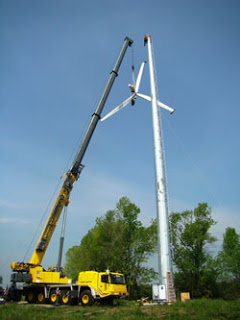
A 50 kW Entegrity wind turbine is installed May 26 on Lakeshore Technical College’s Cleveland campus. The turbine was made operable June 8 and is visible from I-43.
From a news release issued by Lakeshore Technical College:
A second wind turbine is up and running on Lakeshore Technical College’s Cleveland campus, providing additional opportunities for student training and field testing, as well as energy savings for the college.
The 120-foot, 50 kW Entegrity turbine is located just northwest of the LTC Flexible Training Arena. It was installed May 26 with the help of Seventh Generation Energy Systems, and was made operable June 8 following final interconnection tests and inspections by We Energies.
The Entegrity is expected to produce between 75,000 and 91,900 kWh annually — slightly more than the Vestas V-15 turbine, which was erected on campus in 2004. A third turbine, a 50 kW Endurance, will be installed at LTC later this summer.
“The main point of the project is the head-to-head comparison of these three models for energy production, maintenance costs, installation costs and other factors,” said Doug Lindsey, LTC’s dean of Trade and Industry. “We Energies has a strong interest in providing consumer-level field test data on these turbines.”
Regular maintenance on the Entegrity will be performed by second-year students in the Wind Energy Technology associate degree program.
While the two existing turbines — the Vestas and the Entegrity — are similar in size, Wind Energy Technology Instructor Jenny Heinzen said individuals visiting or passing by the campus will notice one key difference.
“The Entegrity is a downwind machine, which means it operates with its blades facing away from the wind,” Heinzen said. “Because the Vestas operates by pointing into the wind, the two will appear to be positioned in reverse directions while operating simultaneously.”
by jboullion | Jul 1, 2010 | Uncategorized
From an news release issued by Excel Energy:
MINNEAPOLIS – Phase One of a comprehensive study released today by a coalition of energy leaders, identifies future transmission needs in the Upper Midwest to support renewable energy development and to transport that energy to population and electricity load centers. Xcel Energy is co-sponsoring the study with Electric Transmission America – a joint venture between subsidiaries of American Electric Power and MidAmerican Energy Holdings Company, American Transmission Company, Exelon Corp., NorthWestern Energy and MidAmerican Energy Company.
The Strategic Midwest Area Transmission Study (SMARTransmission) sponsors retained Quanta Technology LLC to evaluate extra-high voltage transmission alternatives for new transmission development in the Upper Midwest. In phase one, Quanta evaluated eight transmission alternatives designed to support the integration of significant new wind generation within the study area, including North Dakota, South Dakota, Minnesota, Iowa, Wisconsin, Nebraska, Missouri, Illinois, Indiana, Michigan and Ohio. The plans would accommodate the integration of up to 56.8 gigawatts of wind generation. This translates into enough energy to power over 15 million households. If it is determined that less wind energy is needed, transmission recommendations would be adjusted accordingly.
The study’s Phase One results recommend three alternatives for further study based on a rigorous reliability assessment and stakeholder input. One of the alternatives is primarily 765-kilovolt extra-high voltage transmission, another includes 765 kilovolt combined with limited use of high-voltage direct current transmission lines, while the third constitutes a combination of both 345-kilovolt and 765-kilovolt transmission lines. The three alternatives will be evaluated further during the second phase of the study, scheduled for completion during the third quarter of 2010. The Phase One report can be downloaded at www.smartstudy.biz.
by jboullion | Jul 1, 2010 | Uncategorized
From an article by Nick Paulson in the Stevens Point Journal:
If you want a drink of water on the University of Wisconsin-Stevens Point campus this fall, don’t expect to find any bottles for sale.
The university’s new vending contract, which will go into effect before the school year starts in September, bans bottled water sales in campus vending machines. The 30 or so beverage machines also will switch to aluminum cans for soft drinks, cutting additional use of plastic. Only beverages which don’t come in other materials, such as sports drinks, still will be sold in plastic bottles.
UWSP bids its vending contract every five years. When Jerry Lineberger, associate director of University Centers, and other staff members asked for student input on this issue, the biggest call was to get rid of plastics, especially bottled water. The Student Government Association even passed a resolution asking for a reduction.
“If you want water, we have lots of water fountains on campus,” said Lineberger, who put together the new contract. “You can bring your own water bottle and fill it for free.”
Eliminating bottled water and switching to aluminum will cut, possibly by half, the amount of plastic the campus uses. The switch fits in with UWSP’s commitment to sustainability and image as a “green” campus.
But it also has a practical side. Recycling all the plastic costs the university money, but it can make money by selling the aluminum cans.
by jboullion | Jul 1, 2010 | Uncategorized
From an article by Jessica Larsen in The Tomah Journal:
About 40 residents attended a public hearing in Tomah on Tuesday to present their opinions about wind turbine siting to the Public Service Commission.
The PSC held afternoon and evening meetings at the Tomah Holiday Inn. The Tomah hearing was one of several held around Wisconsin.
The general consensus was support for wind turbines as long as there were educated regulations for where and how to build them. Seventeen residents voiced their opinion, and other attendees wrote theirs out in the hour-long meeting.
The information received from each hearing and other submitted testimonies will be reviewed by the commission and incorporated into the Wind Siting Rule this summer. The commission will then send the final Wind Siting Rule to the Wisconsin Assembly and Senate. The rule will be assigned to a committee in each house, and the committees have 30 days to review it and may hold public hearings. After legislative review, the final Wind Siting Rule takes effect.
Vernon County resident Natalie McIntire said she supports the emergence of wind power.
“Wind development will bring benefits to residents like me,” she said. “But if Wisconsin adopts unreasonable rules, it will drive benefits to other states.”
Speakers discussed the bad side effects such as the noise, flicker, health of those near the turbines and loss of scenery.
“I really wish, hope and pray that you would not put these in our country,” said Gurido VonAulock.
by jboullion | Jun 30, 2010 | Uncategorized
From an article by Ryan Whisner in the Jefferson Daily Union:
JEFFERSON – A proposal to build the second-largest solar-generation farm in the United States was presented to City of Jefferson officials Wednesday night.
Green States Energy Inc. of Deerfield Beach, Fla., unveiled plans to build a solar energy farm on 100 acres of the city’s north industrial park that would generate approximately 20 megawatts of electricity.
Jefferson Sun One would have approximately 100,000 individual solar panel modules on the 100-acre parcel. The site – just north of the former Brigg & Stratton plant – would generate approximately 3.5 million kilowatt hours per year, equivalent to generating sufficient electricity for about 3,500 homes. An interconnectivity agreement with Jefferson Utilities and WPPI is intended.
“This is a big deal if it can be brought to fruition and can be built,” said David Jenkins of the Wisconsin Office of Energy Independence.
Currently, he noted, Wisconsin has approximately 6.5 megawatts of installed solar capacity. Only two cities in the state are labeled by the U.S. Department of Energy as solar cities.
“Overnight, if this project were built, the City of Jefferson would have three times as much solar energy as there is in the entire state,” Jenkins said. “As far as I’m concerned, if you had 20 megawatts of power here, you would be a solar city.”
Approximately five to six weeks ago, Jefferson city officials were approached by representatives from Green States Energy about locating the solar energy farm in Jefferson. Green States representatives presented its proposal Wednesday to a joint session of the Jefferson Common Council, Jefferson Plan Commission and Jefferson Redevelopment Authority.
“It is an opportunity for us to not only provide a lot of good jobs in the construction phase and also the operational stage, but it is also an opportunity for the City of Jefferson to create an identity of being a nationwide leader in renewable energy,” Mayor Dale Oppermann said. “We have the task, the challenge and the opportunity to reinvent the economy of Jefferson and the surrounding area.”
He said Green States Inc. is offering the city the chance to get involved with state-of-the-art technology and create an identity for the city as being clean and green.
Green States Energy Inc. chief executive officer Jeffrey Lord described the company as a group of people who have come together under a common principle.
“The planet and the people on it will be better off if we can start using less fossil fuels to get the energy we need,” Lord said, citing the company’s mission.
by jboullion | Jun 30, 2010 | Uncategorized
From an article by Kathleen Foody in the Wausau Daily Herald:
ROTHSCHILD — An environmental advocacy giant has entered the fray surrounding a proposed biomass power plant in Rothschild.
The Sierra Club’s Wisconsin Clean Energy Campaign and the Clean Wisconsin advocacy group this week asked the state’s Public Service Commission to complete an assessment of all the ways the plant could affect the local environment, from noise to potential air or water pollutants.
The biomass plant was proposed by Milwaukee-based We Energies and the Domtar paper mill, where the plant would be built. The $250 million project isn’t subject to an automatic environmental impact statement under state statute, but the Sierra Club and Clean Wisconsin argued in their request that the commission should perform a study anyway.
Jennifer Feyerherm, director of the campaign, said the organization isn’t taking a position for or against the plant, but said a study will provide useful information about the project.
“If we’re going to make decisions about how we create the energy we use, we need as much information as possible,” Feyerherm said.
The Public Service Commission still is in the process of conducting its own environmental evaluation to determine whether a formal study is necessary.
Requests for a study before the commission’s own review is completed are premature, Brian Manthey, spokesman for We Energies, said.
“We continue to provide whatever the commission needs for their environmental assessment,” Manthey said.