by jboullion | May 7, 2008 | Uncategorized
From an article by Stephanie Brien in The Journal Times (Racine):
RACINE — Julie Conigliaro is the proud new owner of a neighborhood electric vehicle, thanks to a City Council decision Tuesday night. Following the City Council’s vote to allow electric vehicles to drive in city limits, Conigliaro signed the dotted line on her new car.
“I’m really happy with it,” said Conigliaro, 41, literally jumping off the ground outside the City Council chambers after they unanimously approved the ordinance. In accordance with state law, the city had to approve an ordinance before neighborhood electric vehicles could be driven within city limits. The new ordinance allows electric cars on all city streets with a speed limit of 35 mph or less.
Madison adopted a similar ordinance in April and Union Grove is in the process of drafting its own ordinance.
“It’s good for the environment, but it’s also good for my pocketbook,” Conigliaro said.
The car cost her $10,500 and will only cost her pennies each time she charges it.
She bought her car from a dealer in Wausau, which is currently only one of five in the state.
Conigliaro lives on 3335 Victorian Dr. and drives four miles every day to her job at SC Johnson.
by jboullion | May 6, 2008 | Uncategorized
From an article by Linda McAlpine on GM Today:
WAUKESHA – From the faux-slate shingles made of recycled baby diapers and rooftop solar panels to its engineered wood floors, the house being built at 1512 Rock Ridge Way in Waukesha is anything but traditional.
The 2,100 square-foot house is the 2008 Wisconsin Trend Home and when completed later this summer will house the latest in energy-saving and environmentally-friendly technology.
Starting at the top, Tim O’Brien, of O’Brien Homes, Waukesha, builder of the home, walked through some of its cutting edge highlights.
“The shingles, which look like slate, are made of recycled baby diapers, tires and plastic bottles,” he said. “Because they’re light, they don’t need the structure to support them so you need less wood. You’re doing something good for the environment by using product made from recycled material. They also have a 50-year life span.”
According to Lisa Schaal, solar site assessor for Sol Power, Milwaukee, the 20 solar panels on the roof enable the house to use about 500 or less kilowatts per month, compared with the average home electricity usage of 800 kilowatts per month.
Dave Schwabenlender, of Arch Electric, LLC of Plymouth, said the panels will generate power even on cloudy days.
by jboullion | May 5, 2008 | Uncategorized
From Amy Flom, We Energies Consultant:
We Energies is offering Renewable Energy Feasibility Study Grants to its business and not-for-profit electric customers, as well as to organizations teamed with We Energies business and non-profit electric customers. This program helps to cover the costs of studying the feasibility of installing a renewable electricity generation project at a customer’s facility. Funds also can be used to conduct research on a renewable energy product or technology, or to help demonstrate or commercially advance a renewable energy product or technology into the marketplace.
How much grant money is available per project?
We Energies will fund half the cost that remains after other funding sources are applied to the cost of the study or project, up to a maximum grant of $200,000. Although matching funds are not required for this grant program, any additional funding that can be added to the proposal will be considered a favorable element of the project and increase the chances for a successful grant. In addition, the We Energies grant funds may be used as matching funds towards a larger State, federal or private grant program, provided the activities of the project meet this program’s objectives, occur in We Energies service territory, and the applicant is teamed with a We Energies business or not-for-profit electric customer.
How do I apply for a We Energies grant?
Please complete the Feasibility Study Grant Application.
Grant proposals will be accepted on an ongoing basis and will be awarded on a first-come, first-served basis, subject to availability of funds.
by jboullion | May 2, 2008 | Uncategorized
From an article by Tom Content in the Milwaukee Journal Sentinel:
More expansion is in the works for Tower Tech Systems Inc. of Manitowoc after its parent company raised $100 million in a stock sale.
Tower Tech is a manufacturer of towers used in wind power projects, a growth area within the manufacturing sector given the record pace in the expansion of wind power generation projects across the country.
For Tower Tech, growth is buoyed in part by an agreement it signed this month to supply wind towers to a subsidiary of the Spanish company Gamesa, a leading player in the global wind industry.
Financial terms of the deal weren’t disclosed, but Broadwind says it is the largest single order for towers placed by Gamesa with a North American tower manufacturer. Delivery from Manitowoc of the 256-foot, four-section wind towers for Gamesa begins this month.
“That’s a significant arrangement to lock in with one of the premier and major wind developers in the U.S.,” said Jeff Anthony of Milwaukee, a manager at the American Wind Energy Association and an active participant in Wisconsin’s renewable-energy sector.
“Gamesa is establishing their presence in the U.S. and is one of the fastest-growing wind turbine suppliers and project developers in the U.S.”
Broadwind Energy Inc. of Naperville, Ill., Tower Tech’s parent company, said it planned to raise $100 million through sale of stock to investment funds managed by Tontine Associates. A separate agreement with an unidentified partner would result in additional financing, Broadwind said.
The proceeds will be used to “accelerate . . . current expansion plans” as well as acquisitions and investments in plans to grow production, the company said.
Lars Moller, chief operating officer, said the company would be poised to expand its production of towers and gears from current locations in Manitowoc and elsewhere, as well as through new factories “strategically placed throughout North America. . . .”
by jboullion | May 1, 2008 | Uncategorized
From an article by Brett Rowland in The Reporter (Fond du Lac):
JOHNSBURG — The status of the Blue Sky Green Field Wind Farm has generated a lot of hot air from locals, but operator We Energies said the 88 turbines haven’t started generating power.
Blue Sky Green Field remains under construction as We Energies tests the turbines, said company spokesman Barry McNulty.
In recent weeks, locals have called and e-mailed The Reporter with rumors about the project, including that it had been shut down due to stray voltage. Another rumor presented to The Reporter stated the turbines were not constructed properly and the blades could come loose.
McNulty denied those rumors and said the project is progressing according to schedule.
“It just goes to show that it doesn’t matter the type of fuel — nuclear, solar, wind — there will always be those who subject themselves to rumor,” he said.
The wind farm is located about 15 miles northeast of the city of Fond du Lac in the towns of Marshfield and Calumet.
A contractor has erected all the turbines and now We Energies is conducting comprehensive tests on each unit. Some have been spinning during test runs, while others remain dormant. McNulty said 60 of the 88 turbines are able to rotate, while work on the others remains in progress.
“The turbines have been spinning at times, but have been taken offline at times,” McNulty said.
McNulty said commercial operations at Blue Sky Green Field would begin about the end of May. . . .
by jboullion | Apr 30, 2008 | Uncategorized
From an editorial in The Journal Times (Racine):
With oil at record prices along with gasoline at the pump, Wisconsin has again awoken to the potential of the free energy flowing in the winds off the shore of Lake Michigan.
We say again because there was a feasibility study in 1992 to assess the potential of wind power from turbines sited just a few miles offshore on the Racine Reef. Last week’s news reports discussed the possibilities which three developers see in generating power from the lake winds with a few hundred turbines placed some miles off the coast. They have not applied to the state for any permits; these are mere concepts, not finished designs. We hope for quick action rather than concepts.
Although one potential developer said his project is on hold while awaiting a method of mooring turbines in deep water, in fact those solutions already exist. Last month a company called Blue H Technologies announced a lease of 40 square miles in the Atlantic Ocean 23 miles south of Martha’s Vineyard for the first deep water wind farm built on floating platforms. In the fall, officials in the United Kingdom unveiled two 5-megawatt turbines placed in 150 feet of water 15 miles off the coast of Scotland.
On the other side of the lake, Muskegon, Mich., is also looking at becoming a wind power capital. Consultants there have calculated that at an extreme, an area of 8,806square miles in the middle of the lake from Beaver Island to Chicago could hold 36,400 towers producing a combined 182,000 megawatts. For comparison, each of the two coal-fired generators being built in Oak Creek will produce 615 MW of power.
One issue for people on shore is the appearance of these modern turbines. These are giants reaching heights of 300 or so feet, and while we wouldn’t want to see such monsters standing on the Racine Reef, turbines 15 or 20 miles off the coast would be barely visible.
There are problems with wind power, no question, starting with the problem that the wind doesn’t blow all the time. But there are solutions to that — backup generating stations or storing excess power as compressed air, for example.
As we said, these ideas have been floating around since at least the early ’90s. It’s time for some action . . .
by jboullion | Apr 29, 2008 | Uncategorized
We Energies is partnering with the Midwest Renewable Energy Association (MREA), Focus on Energy, and local hosts to offer a series of seminars to provide information about generating renewable energy for homes and small business.
PV Systems for Residential Applications covers solar photovoltaic (PV) technology, site selection, system sizing, available financial incentives and installer selection:
May 17 1:00 pm
Outpost Natural Foods
100 E. Capital Drive
Milwaukee, WI 53212
Sept. 27 10:00 am
Milwaukee Area Technical College
Oak Creek Campus
6665 S. Howell Avenue
Oak Creek, WI 53154-1107
Solar Water Heating for Residential Applications covers solar water heating technology, site selection, system sizing, available financial incentives, and installer selection:
May 1 6:00 pm
Good Harvest Market
1850 Meadow Lane
Waukesha, WI
May 17 10:00 am Outpost Natural Foods
100 E. Capital Drive
Milwaukee, WI 53212
Sept. 27 1:00 pm Milwaukee Area Technical College
Oak Creek Campus
6665 S. Howell Avenue
Oak Creek, WI 53154-1107
Go to We Energies’ Web site for more details.
by jboullion | Apr 28, 2008 | Uncategorized
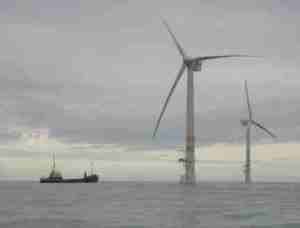
From an editorial in the Wisconsin State Journal:
The exciting possibility of harnessing significant wind power using giant turbines offshore on Lake Michigan moved closer to reality last week.
State officials said three developers are contemplating various ways to erect hundreds of wind turbines on the water that could transmit clean energy back to land.
The plans are only conceptual. Yet state officials are wisely encouraged and seriously exploring several options, potential costs and hang-ups.
Wisconsin is not a windy state. And attempts to build giant wind turbines on land in the past have faced fierce opposition from some neighbors who don ‘t like the look or sound of them.
That ‘s what makes the prospect to putting turbines on lakes Michigan and Superior so appealing. The wind over the lakes is notoriously strong. And if positioned far enough off land, the turbines won ‘t be visible to shoreline property owners who might otherwise object.
Photo from the National Renewable Energy Lab.
by jboullion | Apr 18, 2008 | Uncategorized
From a report just released by the Wisconsin Public Interest Research Group (WISPERG:
Milwaukee, WI – The KRM Commuter Rail line and other public transportation projects received a boost as civic leaders held an event at the Milwaukee Intermodal Station calling for approval of financing and citing a major new report on oil savings and other benefits from public transportation across the country. The WISPIRG report, A Better Way to Go: Meeting America’s 21st Century Transportation Challenges with Modern Public Transit, examines the challenges faced by America’s transportation system and the benefits of existing rail and bus projects in Wisconsin and other states.
According to the report, transit in Milwaukee is responsible for 1.1 million gallons of oil saved and $3 million dollars saved that would have otherwise been spent on gas. With rising gas prices, the report underscored the value and need for lawmakers to invest in transit. Around the country transit saves 3.4 billion gallons of oil each year, prevents 541 million hours of traffic delay and reduces global warming pollution by 26 million tons. Demand for public transportation is booming nationally, with transit trips far outpacing the growth of auto miles or population since 1995.
by jboullion | Apr 16, 2008 | Uncategorized
From Hans Noeldner:
Citizens!
Let’s challenge the Wisconsin Governor’s Task Force on Global Warming to take its own medicine! Please contact the co-chairs and urge them to:
(1) Determine the “Carbon Footprint” of the Task Force’s upcoming
meeting on Thursday, April 18
(2) Establish specific greenhouse gas reduction targets for
subsequent Task Force meetings
(3) Announce the Task Force’s April 18 “Footprint” and its reduction
targets (via press conference or press release)
(4) Measure “Carbon Footprints” for all subsequent meetings
(5) Provide the public with a final report
Email your request to:
Tia Nelson, co-chair tia.nelson@wisconsin.gov
Roy Thilly, co-chair rthilly@wppisys.org
———-
Background
———-
(1) The job of the Task Force on Global Warming is to design policies
that will slash Wisconsin’s greenhouse gas emissions 60 to 80% below
1990 levels by the year 2050.
(2) Unfortunately, preliminary calculations indicate that the Task
Force’s current policy recommendations fail to even reduce emissions
below current levels. Clearly there is MUCH MORE work to do!
(3) Why should the Task Force measure its own Carbon Footprint and
establish its own reduction goals? Because when Task Force members
begin to “walk the talk”, they will make an essential shift in their
THINKING – from the abstract and hypothetical to specific ACTIONS
here and now – for example, on their way to and from Task Force
meetings.
(4) Is this a tall order? No. Here is what needs to happen:
a. Task Force members who drive to meetings would either record
actual fuel consumption or estimate fuel consumption based on
distance traveled and MPG for their vehicle
b. In lieu of recording actual travel distances, driving members
could use Google Maps to compute their totals
c. Wisconsin Public Power Inc. would measure/estimate/prorate heating
and electrical consumption in facilities used by the Task Force
d. Task Force support staff would compute the totals