by Michael Vickerman | Feb 8, 2018 | Wind
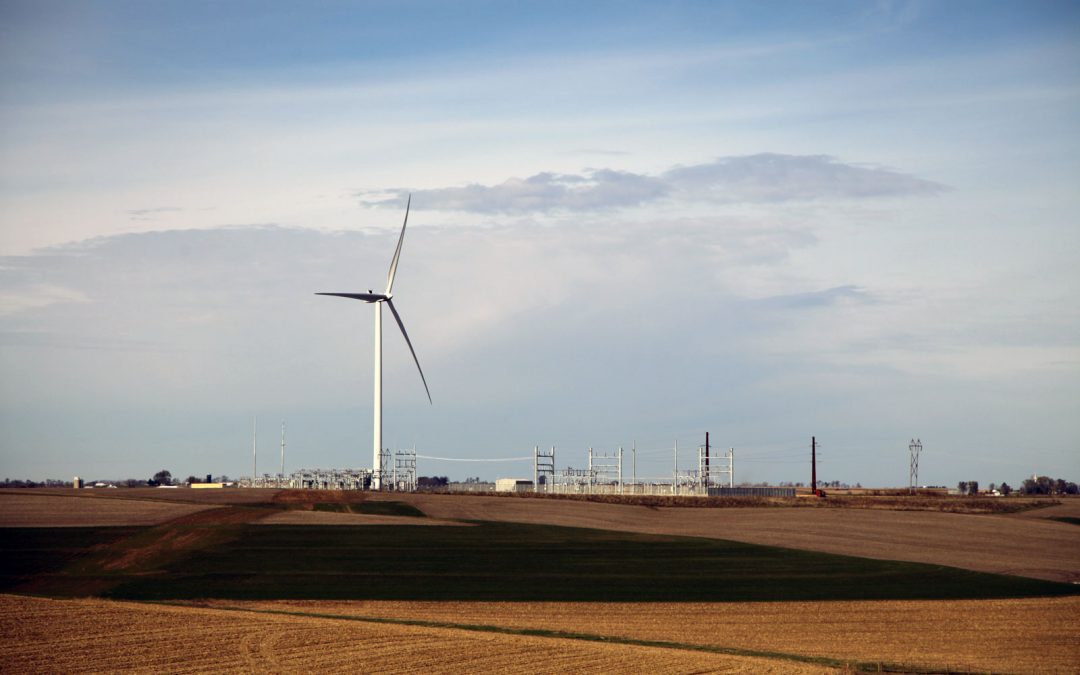
As reported in the American Wind Energy Association’s (AWEA) most recent snapshot of market activity, U.S. developers and electric utilities installed more than 4,000 megawatts (MW) of wind power capacity in the fourth quarter of 2017, accounting for more than half of the total wind generation placed in service over the last 12 months. In the final three months of 2017, 29 new wind farms came online across 16 states, including the 49-turbine, 98 MW Quilt Block project in southwest Wisconsin.
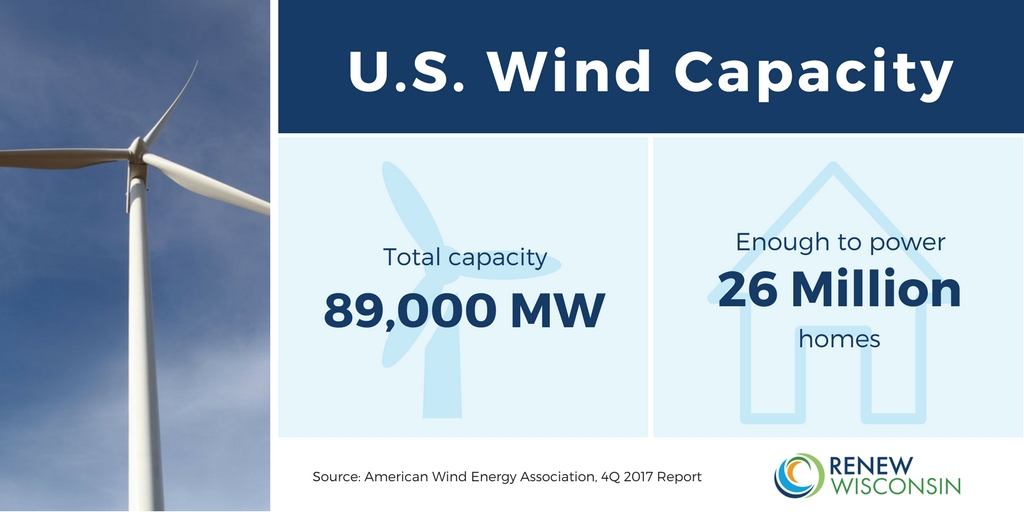
The 7,000 MW of wind turbines built last year pushed total U.S. capacity to more than 89,000 MW, which in an average year should produce enough electricity to equal the annual consumption from 26 million households. Wind power accounts for more than 8% of U.S. generating capacity in the United States today according to the U.S. Energy Information Administration.
Development activity last year was particularly robust in the states of Texas, Oklahoma, Kansas, and Iowa. Large wind energy projects also sprouted up across the Upper Midwest, the second-most active region after the Southern Plains states.
Quilt Block is the first utility-scale wind energy installation to come online in Wisconsin since WEC Energy’s Glacier Hills project in 2011. Owned and operated by Houston-based EDP Renewables, Quilt Block is now the most productive wind power project in the Badger State. La Crosse-based Dairyland Power Cooperative purchases the output from this project to supply the distribution cooperatives and municipal utilities in its system.
According to the AWEA report, the powerful growth experienced by the wind industry last year should continue in 2018 and beyond. The pipeline of wind farms under construction or in advanced development totals 28,668 MW, about one-third of the wind generating fleet now operating in the United States. Projects in the development pipeline should be completed and operating before the end of 2019.
Said AWEA ceo Thomas Kiernan in a press release: “This American success story will continue, with the wind project construction and advanced development pipeline four times greater than the amount installed in 2017. That means tens of billions in additional infrastructure investment is on its way to the United States of America.”
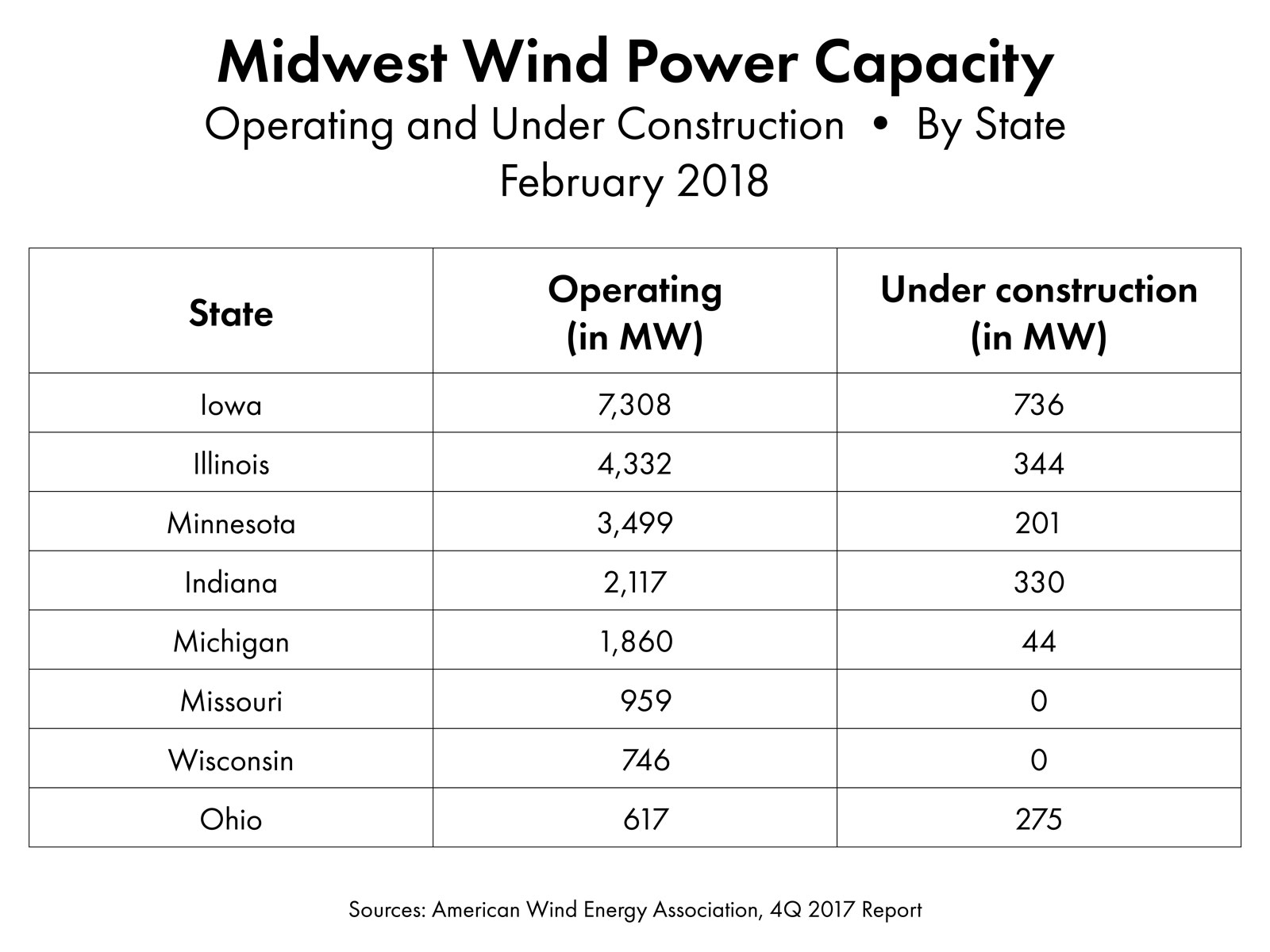
Among Upper Midwest states (see table below), the near-term outlook for future wind development ranges from very active (states beginning with the letter “I”) to quiet (Missouri and Wisconsin). In Wisconsin, there is no project in the development pipeline right now, a consequence of the ongoing absence of policy drivers for renewables and the comparative ease of permitting and building wind projects in neighboring states. It should be noted that two Wisconsin utilities are planning to add wind power to its power supplies this year, Madison Gas & Electric from a 66 MW installation in Iowa, and WPPI Energy from a 132 MW project in Illinois.
by Tyler Huebner | Jan 23, 2018 | Biogas, Policy, RENEW Wisconsin, Renewables, Solar, Wind
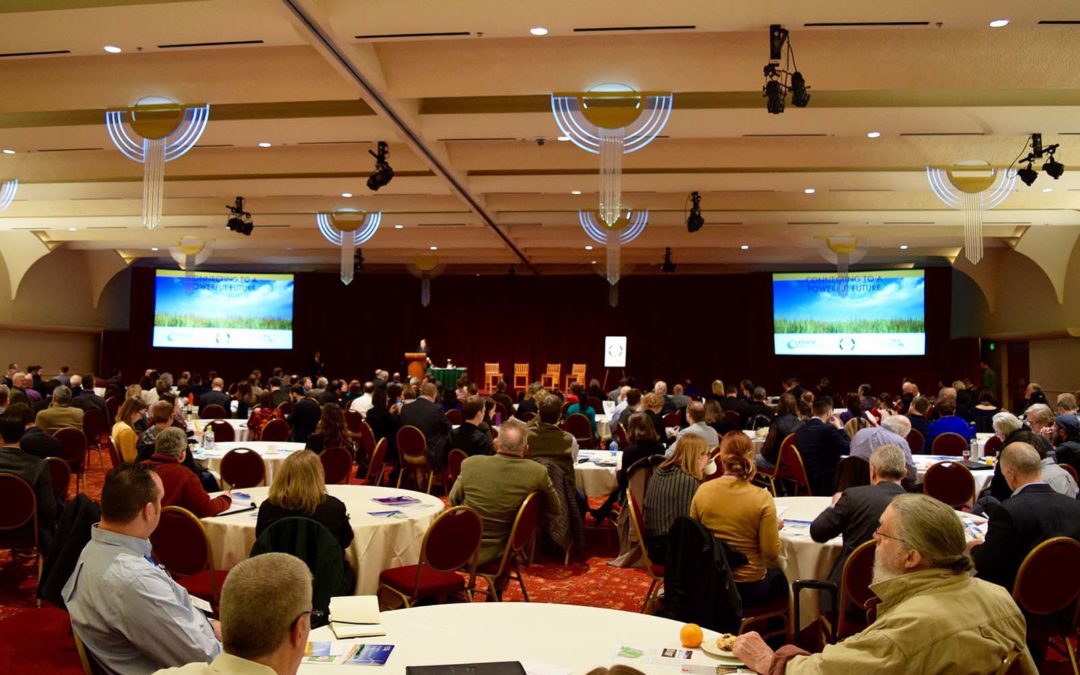
There was a palpable sense of excitement and our largest crowd ever (330 attendees), for our 7th Annual Renewable Energy Summit held January 18th. This year’s Summit, “Connecting to a Powerful Future,” included NextEra Energy Resources as a Presenting Sponsor.
Wind energy is coming back to Wisconsin as evidenced by the 2017 addition of Quilt Block Wind Farm, which was awarded the Renewable Energy Project of the Year.
Solar energy had its best year ever – for the 3rd consecutive year. The total amount of solar power capacity in Wisconsin has grown to 80 megawatts, enough to power over 10,800 Wisconsin homes. That’s up from 42 megawatts twelve months ago and 25 megawatts the year before that.
Our panel of utility executives and our solar industry speakers described the growth in solar, and the future opportunities on the horizon.
And biogas, which has struggled in recent years, is finding new opportunities. Dane County Executive Joe Parisi described the county’s plans to transform their landfill from electric generation to gas injection to a pipeline, and how it will also facilitate local biodigesters to do the same.
Bringing home our theme of “Connecting to a Powerful Future,” we learned how to improve our clean energy communications from Jane Bloch of Tusculum Consulting. Jane’s specialty in conveying the benefits of clean energy to broad audiences will help all of us continue to expand renewable energy in Wisconsin.
We also named John & Mary Frantz of Madison and Cal & Laurie Couillard of Deerfield Renewable Energy Champions for their support and philanthropy which enables RENEW Wisconsin to continue growing. John & Mary have been matching donors to our Ride with RENEW bicycle events, and Cal & Laurie founded Solar for Good to help Wisconsin mission-driven nonprofits “go solar.”
Our exhibition hall had 27 vendors, our most ever, and the networking was consistently described by many attendees as “excellent.”
Please check out the presentations from the day and photos of the event, and plan to join us at next year’s event!
Also, we encourage you to check out the media coverage of the day:
RENEW Wisconsin: Big Increase in Solar Energy Expected in Next Few Years (Chuck Quirmbach, Wisconsin Public Radio, January 18, 2018)
Cost-Effectiveness of Solar, Other Renewables Expected to Keep Growing (Alex Moe, WisBusiness.com, January 19, 2018)
Thank you to our 2018 Summit Sponsors!
by Jodi Jean Amble | Jan 11, 2018 | Advocacy, Policy, RENEW Wisconsin, Renewables, Solar, Wind
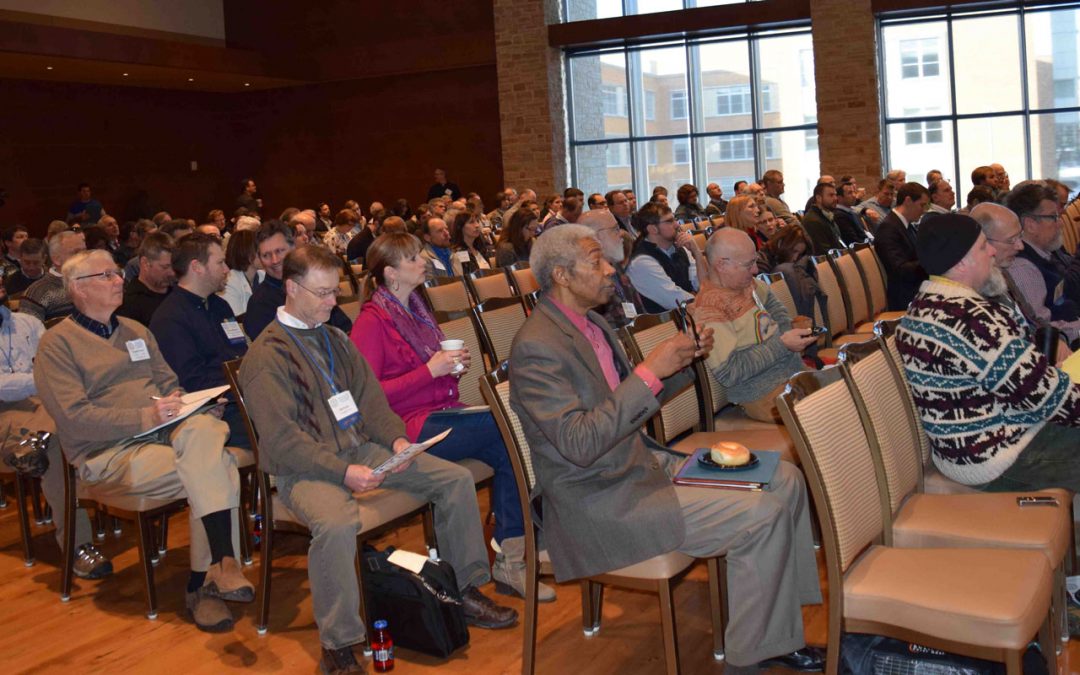
RENEW’s seventh annual Renewable Energy Summit, set for January 18, 2018, will furnish the occasion for recognizing the leading lights in Wisconsin’s renewable energy industry and spotlighting the developments that made 2017 such a stellar year. Titled “Connecting to a Powerful Future,” RENEW’s Summit will take place at Monona Terrace in Madison; registration starts at 8:00 AM and the program runs from 9:00 AM to 3:30 PM. The recognition ceremony will begin at 2:00 PM.
Last year saw the first large-scale wind power plant go up in Wisconsin since 2011. Quilt Block, a 49-turbine, 98-megawatt (MW) project developed by Houston-based EDP Renewables is now online, producing power under contract to La Crosse-based Dairyland Power Cooperative, whose four-state service area includes 18 member cooperatives and 10 municipal utilities in Wisconsin.
Representing a capital investment of $167 million, EDP’s Quilt Block project will produce enough renewable electricity to power more than 25,000 Wisconsin residences while providing millions of dollars in local aids to the Town of Seymour and Lafayette County, as well as lease payments to participating landowners over the plant’s operating life.
At the Summit, RENEW will honor Quilt Block Wind Farm as Wisconsin’s Renewable Energy Project of the Year. Recognizing the strong collaboration forged by project participants, RENEW will present plaques to representatives of the developer (EDP Renewables), the utility purchaser (Dairyland Power Cooperative), local governments (Town of Seymour, Lafayette County), and participating landowners.
Last year marked the emergence of RENEW Wisconsin’s Solar for Good, a program that provides grants to nonprofit institutions that seek to install solar electric systems on their buildings. Initiated by donations from Deerfield-based philanthropists Cal and Laurie Couillard, Solar for Good awarded 16 grants in 2017 supporting the installation of 573 kilowatts (kW) of new solar electric projects to serve such entities as public charter schools, food pantries, houses of worship, and nursing care facilities. For their philanthropy that made possible the Solar for Good program, Cal and Laurie Couillard will receive honors as Renewable Energy Champions.
Also set to receive honors as Renewable Energy Champions are John and Mary Frantz, both retired physicians and long-time renewable energy advocates now living in Madison who have been generous supporters of RENEW Wisconsin’s work to expand renewable energy. In recent years, their generosity has taken the form of providing matching donations to “Ride with RENEW,” a fundraising event held in autumn featuring bicycle tours of noteworthy renewable energy projects in Wisconsin.
The recognition segment will also draw attention to other milestones and notable achievements in 2017, including the following:
- All 15 solar arrays built by SoCore Energy (Illinois) and GroSolar (Vermont) under contract to Dairyland Power are now producing electricity. Three of the arrays, located in New Auburn, Phillips, and Roberts, are the state’s largest in operation.
- Xcel Energy’s Wisconsin utility commissioned a 1 megawatt (MW) array in Eau Claire, which now supplies energy to its shared solar subscribers.
- SunPeak designed and built the state’s largest rooftop solar electric system in operation, a 1.2 MW array atop the American Family Insurance headquarters building in Madison.
- Eagle Point Solar installed 350 kilowatts (kW) of solar generation atop two schools in the Northland Pines School District, which now has more solar capacity than any other K-12 district in Wisconsin.
- SunVest Solar and Current Electric teamed up to design and install 800 kW of solar capacity on six rooftops in the Oneida Nation reservation in Brown County.
- Contractors partnered with local nonprofits to launch five residential group solar purchase programs across Wisconsin. Together these initiatives result in 158 installations totaling nearly 1,000 kW of new solar capacity.
“These award winners and honorable projects deserve recognition for the benefits they are bringing Wisconsin’s people and economy,” said Tyler Huebner, RENEW Wisconsin’s Executive Director. “These honorees are leading the way towards a clean, vibrant, and self-sustaining Wisconsin energy future.”
For more information on the 2018 Summit program agenda, speakers, and registration, please visit http://www.renewwisconsin.org/2018_Summit/index.html.
by jboullion | Jul 11, 2016 | Utility Scale, Wind
At an open meeting on July 7th, the PSC met to resolve the specific issues that led St. Croix County Circuit Court Judge Edward Vlack to invalidate the Certification of
Public Convenience and Necessity (CPCN) granted to the 102.5 MW Highland
Wind Farm in 2014 and remand the matter back to the agency.
Specifically, the judge wanted a firmer foundation for the additional
restrictions on sound levels that were established for six residences
presumed to be occupied by sensitive individuals.
On a 2-0 vote, the PSC ruled that the body of literature examining potential health impacts from wind generators did not support the imposition of a special sound threshold for those six residences. In explaining her decision, Commission Chair Ellen Nowak said that the agency’s review of peer-reviewed studies did not find a causal connection between wind turbines and claims of adverse health impacts. In reaffirming its approval of Highland Wind, the agency removed a stipulation in the permit that specified reduced noise limits from nearby wind turbines for the six residences in question. Instead, the agency agreed to set a uniform sound limit for the entire project, and will rely upon a complaint process to address sound concerns.
Opponents of the project have said they are considering their legal options and plan to “continue to fight against Highland Wind in any way we can.”
by jboullion | Jun 8, 2016 | Utility Scale, Wind
More information
Tyler Huebner, Executive Director
608-575- 2201 (cell)
tyler.huebner@renewwisconsin.org
RENEW Applauds Dairyland Power and EDP Renewables for Wind Energy Expansion
|
| Also in southwest Wisconsin, the Montfort Wind Farm |
Madison, WI – June 8, 2016
Today, Dairyland Power Cooperative, based in La Crosse, announced they will purchase power from a new utility-scale wind energy project in Lafayette County in southwest Wisconsin.
The “Quilt Block” wind project will be developed by EDP Renewables, which has its U.S. headquarters in Houston, Texas. The project is approximately 98 megawatts, which when constructed will provide over 15% of Wisconsin’s wind power.
RENEW Wisconsin’s Executive Director, Tyler Huebner, said “We congratulate and applaud Dairyland Power Cooperative and EDP Renewables for this major clean energy venture that will bring a multitude of benefits to southwest Wisconsin and Dairyland Power members throughout the state. Dairyland is making the most of the opportunity at hand to lock in the benefits of low-cost clean energy for its member cooperatives.”
The project will deliver savings to ratepayers as well as stimulate the local economy. Quilt Block will yield an annual revenue stream of nearly $400,000 to Lafayette County and the Town of Seymour, while creating hundreds of family-supporting jobs during construction. All across the Midwest, rural local governments have relied on utility-scale wind generation to minimize property tax increases.
Huebner said, “We also salute EDP Renewables for designing a wind power project that is strongly supported by the local community, and for staying with it for more than a dozen years.”
Concluded Huebner, “Between WPPI Energy’s recent windpower request-for- proposals announcement earlier this week, Dairyland’s multimegawatt solar energy initiative, and its new wind power project, renewable energy is now clearly cost-competitive in Wisconsin.”
Dairyland’s press release can be found at http://www.dairylandpower.com/dcontent/article/DPCWindExpansion75thAnnualMtg2016.pdf
This story was covered in the Milwaukee Journal Sentinel and the La Crosse Tribune.
by RENEW Wisconsin | Sep 26, 2013 | Utility Scale, Wind
An article by Tom Content documents how the PSC reversed course on the Highland Wind Farm project, which has now been approved:
After initially rejecting the plan, Wisconsin energy regulators gave the go-ahead Thursday for Emerging Energies to build a $250 million wind farm in western Wisconsin.
The state Public Service Commission approved the St. Croix County wind farm in a 2-to-1 vote, with commission Chairman Phil Montgomery agreeing to support the project.
Earlier this year, Montgomery and commissioner Ellen Nowak had rejected the plan, saying the developer hadn’t shown it was able to comply with the state’s noise standard for wind turbines.
But they opened the door to Emerging Energies to show how it could comply with the standard, and the developer followed up, indicating it could comply with the standard by curtailing some of the turbines at night.
Montgomery said Thursday he was satisfied with the developer’s curtailment plan, but wanted to see documentation that the wind turbines are programmed to meet the noise standard — and that the project developers follow up “with adequate measurement and monitoring.”
In a statement after the vote, the conservation group Clean Wisconsin praised the panel’s 2-to-1 decision.
“Today’s decision is a victory for cleaner air and water in Wisconsin,” said Katie Nekola of Clean Wisconsin in a statement. “The Highland Wind project will supply enough clean, safe electricity to power hundreds of homes and businesses, and will displace dirty coal power.”
If the project moves forward to construction, the Highland Wind Farm in the town of Forest in St. Croix County would consist of up to 44 wind turbines, generating 102.5 megawatts of electricity.
Look for updates later today on JSOnline.
[READ ORIGINAL ARTICLE]