by jboullion | Jun 8, 2016 | Utility Scale, Wind
More information
Tyler Huebner, Executive Director
608-575- 2201 (cell)
tyler.huebner@renewwisconsin.org
RENEW Applauds Dairyland Power and EDP Renewables for Wind Energy Expansion
|
| Also in southwest Wisconsin, the Montfort Wind Farm |
Madison, WI – June 8, 2016
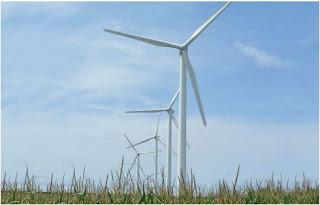
Today, Dairyland Power Cooperative, based in La Crosse, announced they will purchase power from a new utility-scale wind energy project in Lafayette County in southwest Wisconsin.
The “Quilt Block” wind project will be developed by EDP Renewables, which has its U.S. headquarters in Houston, Texas. The project is approximately 98 megawatts, which when constructed will provide over 15% of Wisconsin’s wind power.
RENEW Wisconsin’s Executive Director, Tyler Huebner, said “We congratulate and applaud Dairyland Power Cooperative and EDP Renewables for this major clean energy venture that will bring a multitude of benefits to southwest Wisconsin and Dairyland Power members throughout the state. Dairyland is making the most of the opportunity at hand to lock in the benefits of low-cost clean energy for its member cooperatives.”
The project will deliver savings to ratepayers as well as stimulate the local economy. Quilt Block will yield an annual revenue stream of nearly $400,000 to Lafayette County and the Town of Seymour, while creating hundreds of family-supporting jobs during construction. All across the Midwest, rural local governments have relied on utility-scale wind generation to minimize property tax increases.
Huebner said, “We also salute EDP Renewables for designing a wind power project that is strongly supported by the local community, and for staying with it for more than a dozen years.”
Concluded Huebner, “Between WPPI Energy’s recent windpower request-for- proposals announcement earlier this week, Dairyland’s multimegawatt solar energy initiative, and its new wind power project, renewable energy is now clearly cost-competitive in Wisconsin.”
Dairyland’s press release can be found at http://www.dairylandpower.com/dcontent/article/DPCWindExpansion75thAnnualMtg2016.pdf
This story was covered in the Milwaukee Journal Sentinel and the La Crosse Tribune.
by jboullion | Jun 6, 2016 | Uncategorized
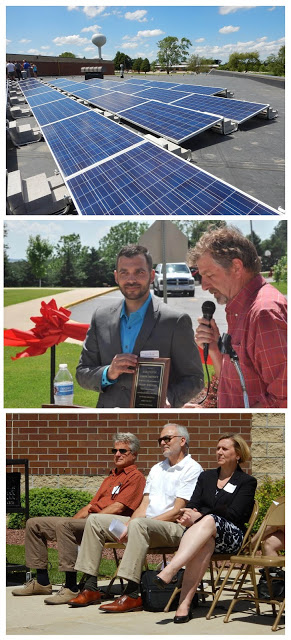
The Darlington Community School District kicked off the month of June with a ribbon-cutting
ceremony in honor of its solar electric system installed late last year and energized this winter.The 156 kilowatt array atop the elementary-middle school is, according to RENEW’s project data base, the largest photovoltaic array serving a public school system in the state.
A southwest Wisconsin community with a population of nearly 2,500, Darlington is the seat of government in Lafayette County. There are about 800 students enrolled in the school district.
Under blazing sunshine and a cobalt blue sky, RENEW’s Michael Vickerman presented a plaque to Darlington School Board president Aaron Wolfe honoring the district’s achievement in becoming “the largest solar electricity producer of any K-12 school district in Wisconsin.”
Vickerman said: “We are delighted to present this award to you not only to recognize your great achievement with this solar installation, but also to inspire other school districts in Wisconsin to equal or surpass what you’ve accomplished here in Darlington.”
Consisting of 510 panels expected to generate 200,000 kilowatt-hours/year, Darlington’s array is sized to supply 25% of the electricity consumed at both the high school and the neighboring elementary school. The school district expects to save about $11,500 annually in electricity costs.
Working closely with Madison solar consultant Niels Wolter, the school district obtained a $63,000 renewable energy incentive from Focus on Energy and a $61,000 grant from U.S. Department of Agriculture’s Rural Energy for America Program. Midwest-based solar investors also provided funding for the installation.
The district also received Hoffman’s 2016 TPM ™ sustainability award from Mark Hanson, Director of Sustainable Services, with Appleton-based Hoffman Planning, Design and Construction, Inc., which provided solar planning services.
After the ribbon was cut, Lee Black, the district’s buildings and grounds manager, shepherded a group up to the roof to view the installation and answer questions.
For more information on the Darlington Solar Education Project, visit their website here.
Real-time monitoring information from the Darlington array can be accessed here.
by jboullion | May 31, 2016 | Uncategorized
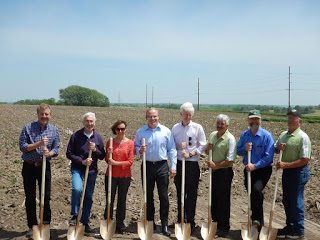
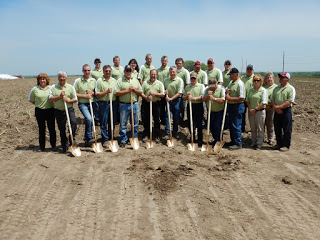 Representatives from Dairyland Power Cooperative, Richland Electric Cooperative, SoCore Energy and others gathered May 23rd on a sun-baked Richland County crop field
to celebrate a breakthrough moment for utility-scale solar energy in
Wisconsin. The symbol for this breakthrough is a 600 kilowatt (AC) solar
array that will, when completed, supply 500 kW of electricity to
Dairyland Power and 100 kW directly to Richland Electric under a 25 year
contract.
The third participant in the groundbreaking ceremony, Chicago-based SoCore Energy, will build and own the Richland solar station as well as 10 others across western Wisconsin. La Crosse-based Dairyland Power and its host cooperatives will purchase the entire output from SoCore’s 11 arrays, which will total more than 14 megawatts.
Highlighting the course change that Dairyland and its member cooperatives are committed to, every Richland Electric employee present at the ceremony wore green shirts emblazoned with “Transition Energy.” This fact sheet contains more details on Richland’s Transition Energy initiative.
Presiding over the ceremony were Barb Nick, Dairyland Power’s CEO, and Shannon Clark, Richland Electric’s general manager. Both speakers praised solar power’s emergence as a clean, cost-effective, and locally available source of energy that complements the western Wisconsin landscape. Consisting of nearly 2,400 panels, SoCore’s array will occupy about one-half of an eight-acre parcel next to a Dairyland substation alongside State Highway 56.
[RENEW note: Barb Nick will be the keynote speaker at RENEW’s Energy Policy Summit set for January 2017.]
At the groundbreaking, Richland’s Clark unveiled details of the shared solar component to the project, which it calls the Ash Ridge Community Solar Project. Nearly 400 310-watt panels will be dedicated to Richland’s shared solar service, which is available to all of the cooperative’s 3,500 owner-members. The one-time subscription fee per panel is $699. The per-kilowatt- hour credit to subscribers will equal the cooperative’s retail energy rate.
Also participating in the groundbreaking were State Senator Jennifer Shilling, and State Assembly members Ed Brooks and Lee Nerison. WXOW-TV, Channel 19 in La Crosse, broadcast a segment on the groundbreaking that evening and aired a lengthier segment on solar energy’s breakthrough moment the following morning.
by jboullion | May 11, 2016 | Uncategorized
A letter to customers in Xcel Wisconsin’s territory from RENEW’s Michael Vickerman appeared in the
La Crosse Tribune on April 26, 2016:
|
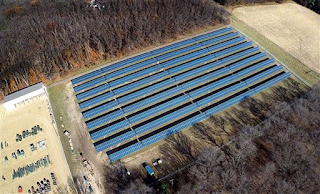
Eau Claire Energy Cooperative’s
872 kW Community Solar Array |
With declining costs, solar electricity has become an increasingly affordable option for property owners wishing to power their homes with clean energy.
But what options are available for solar energy enthusiasts who have shading problems or roofs that need replacement within the next five years? And is there any path available for renters who want solar but don’t own the roof over their heads?
There is an option for La Crosse-area customers of Xcel Energy—every customer now can “plug in” to a community solar garden and reap the benefit of that clean energy directly on their electric bills.
With the recent rollout of Xcel’s Solar*Connect Community program, residential and business customers are stepping up to purchase a share in the output through up-front subscriptions that will likely be paid back in full after 20 years. Hopefully, their early action will inspire others in La Crosse and surrounding communities to join in and reap the solar harvest.
Grouping thousands of solar panels into one large array lowers the unit cost of the project to participants. Through this structure, every participating utility customer will share equitably in this clean power installation at a low cost.
Another segment of the community that benefits from shared solar is the nonprofit sector, which can solicit tax-deductible contributions from its members or donors to become solar buyers. Indeed, community solar is a great way for a benefactor to bestow a clean energy legacy for a particular school, nature center or house of worship.
Solar projects like these do not drop out of the sky and magically land in your community. These arrays are going up in western Wisconsin because the people there and utilities such as Xcel believe that their communities are ready to launch the transition to clean energy, and they worked hard to make these projects happen. They also believe that solar is a cost-effective energy option today when customers are given the opportunity to step up and support it.
La Crosse-area residents and businesses are fortunate to have this opportunity to take their energy future into their own hands. To Xcel customers living in the area, we at RENEW encourage you to make the most of this opportunity and enroll in your local solar program. There is no clearer way to show the world where you and your community stand on clean energy.
by jboullion | Mar 28, 2016 | Uncategorized
By: Tyler Huebner, Executive Director, RENEW Wisconsin
Last week, two reports came out that demonstrate the incredible value of Wisconsin’s Focus on Energy program to our state’s citizens and economy.
Focus on Energy is the program that people and businesses across the state use for rebates, advice, and technical support to save money by using less energy.
The first was a report issued by a group called the Clean Energy Trust. It showed the number of people across 12 Midwest states who work in the delivery of energy saving products and services and renewable energy technologies.
In Wisconsin, we have nearly 25,000 people working in these industries according to the report. Companies like Miron Construction in Neenah, Broadwind Towers in Manitowoc, Cree Lighting in Racine, Trane in La Crosse, and countless small businesses throughout the state are delivering energy solutions for businesses and residents.
However, of the twelve Midwestern states surveyed, Wisconsin ranked last in the number of persons working in these industries on a per capita basis. The report clearly shows that Wisconsin has a tremendous opportunity to tap these sectors for further employment growth.
The second report was a draft “Strategic Energy Assessment” from the state of Wisconsin’s Public Service Commission. This report showed that Wisconsin has the highest electricity rates of eight Midwestern states.
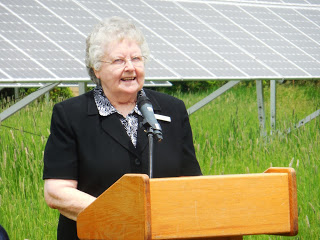 |
Sisters of St. Francis Solar Installation, which was made
possible by a Focus on Energy Rebate. |
However, because our citizens use energy more efficiently, our monthly energy bills aren’t the highest. In fact, our monthly bills are among the lowest in the region.
The Public Service Commission identified the energy-smart nature of our citizens and specifically pointed to the Focus on Energy program for enabling citizens to save money on their monthly bills.
It’s against the backdrop of these reports that our Legislature has recently passed a bill, AB 804, that cuts $7 million each year out of Wisconsin’s highly successful Focus on Energy program. The bill is sitting on the Governor’s desk, and it is my understanding that the Governor has the ability to line-item veto that provision in the bill.
Funding for Focus on Energy should be kept whole.
Focus on Energy delivers $3.33 in savings for every dollar invested. The program keeps energy bills lower for citizens and businesses, despite Wisconsin’s higher rates. Focus on Energy is supporting thousands of jobs, but Wisconsin is behind our neighboring states. A cut to this program will only make that gap larger.
More jobs. Less waste. Saving money. Common sense goals for a stronger Wisconsin, and Focus on Energy is delivering. Let’s keep this program strong now, and for years to come.

by jboullion | Mar 22, 2016 | Uncategorized
FOR IMMEDIATE RELEASE
PRESS CONTACTS: Tyler Huebner, Tyler.Huebner@renewwisconsin.org, 608-575-2201; Pat Mitchell, pmitchell@hastingsgroup.com, 703-276-3266; Jeff Benzak, jeff@e2.org; 202-513-6248.
New Report: Nearly 25,000 Clean Energy Workers in Wisconsin
Projected 2016 Growth Rate of 4.8 Percent; Milwaukee, Rural Areas Each Account for Quarter of State’s Jobs; Energy Efficiency, Renewables Standards Could Create Even More Opportunities
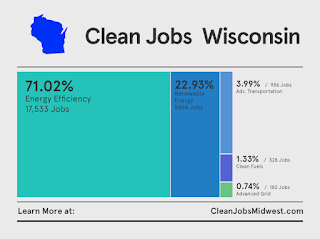
MADISON (March 22, 2016) – Nearly 25,000 people work in Wisconsin’s clean energy industry, according to a comprehensive analysis unveiled today by RENEW Wisconsin, Clean Energy Trust and Environmental Entrepreneurs (E2).
The analysis – available at www.CleanJobsMidwest.com – is based on U.S. Bureau of Labor Statistics data and a comprehensive survey of thousands of businesses across Wisconsin and the 12-state Midwest region. The Clean Jobs Midwest report provides detailed breakdowns of clean energy jobs not available previously – including job totals for every county, congressional district and state legislative district in Wisconsin.
“As a leading wind tower manufacturer in the U.S., Broadwind draws on Wisconsin’s deep manufacturing heritage to fabricate wind turbine towers in our Manitowoc facility,” said Eric Blashford, president of Broadwind Towers and Heavy Industries, referring to the company’s Wisconsin location on Lake Michigan between Milwaukee and Green Bay.
“This same facility that once built submarines for World War II currently employs nearly 300 people in Manitowoc, most of whom are high-skilled manufacturing staff receiving competitive pay and a good benefits package.”
“As Wisconsin transitions to a clean energy economy, many more of these well-paying jobs will be created throughout the supply chain helping Wisconsinites make a good, stable living,” Blashford said.
Energy efficiency is by far the largest clean energy sector employer in the state, with more than 17,000 people, or nearly 71 percent of the clean energy workforce, employed in areas such as high-efficiency lighting, Energy Star appliance manufacturing and high-efficiency HVAC services to reduce wasted energy in homes, schools and businesses.
According to the findings, the renewable energy industry accounts for about one in four clean energy workers in Wisconsin, or more than 5,600 jobs – including about 3,700 in solar, 1,100-plus in biomass and nearly 600 in wind. Wisconsin is one of two Midwestern states with more than 20 percent of its renewable energy generation coming from biomass.
“Wisconsin’s clean energy workers make up an important and growing sector of our economy,” said Tyler Huebner, executive director of RENEW Wisconsin. “Our last major state energy policy advancement was made ten years ago now, and although we met the goals including 10 percent renewable electricity by 2015, that policy is no longer driving investment. A new policy framework for advancing 21st-century energy solutions would create even more clean energy employment and help us catch up with our neighboring states. Clean energy policies drive job growth across the Midwest and have the potential to help create thousands of good-paying jobs in Wisconsin as well,” Huebner said.
The report also found:
– Most clean energy jobs in Wisconsin – nearly 7,500 – are found in rural areas and non-metropolitan statistical areas. The greater Milwaukee area boasts nearly 6,500 clean energy jobs.
– In contrast to Governor Scott Walker’s policy opposing the federal Clean Power Plan, nearly 68 percent of clean energy businesses in the state believe the Clean Power Plan would increase business prospects.
– Clean energy employs nearly 569,000 people across the 12-state Midwest region (Illinois, Indiana, Iowa, Kansas, Michigan, Minnesota, Missouri, Nebraska, North Dakota, Ohio, South Dakota, and Wisconsin).
“Clean energy is a dynamic sector and central to economic growth in the Midwest,” said Erik Birkerts, Chief Executive Officer of Clean Energy Trust. “Smart public policy will further accelerate the clean energy sector’s growth, which means thousands of new jobs created across the region and which will confer economic advantages on Wisconsin,” Birkerts continued.
Learn more about Wisconsin clean energy jobs here, and access additional resources for each state and region here.
RENEW Wisconsin leads and accelerates the transformation to Wisconsin’s renewable energy future through advocacy, education, and collaboration.
Clean Energy Trust (CET) fuels clean energy innovation in the Midwest. A Chicago-based non-profit, CET helps launch, fund and grow Midwest clean energy companies to ensure a more prosperous, sustainable future for generations to come. It does this through direct investment, commercialization assistance, mentorship, access to its broad partner network and the promotion of a supportive clean energy community and business climate. Learn more at http://www.cleanenergytrust.org.
Environmental Entrepreneurs (E2) is a national, nonpartisan group of business leaders, investors, and professionals from every sector of the economy who advocate for smart policies that are good for the economy and good for the environment. Our members have founded or funded more than 2,500 companies, created more than 600,000 jobs, and manage more than $100 billion in venture and private equity capital. For more information, see www.e2.org or follow us on Twitter at @e2org.
by jboullion | Mar 14, 2016 | Uncategorized
|
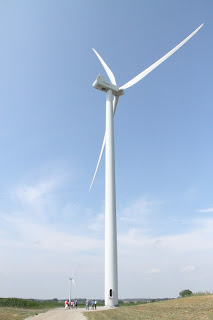
| Glacier Hills Wind Project |
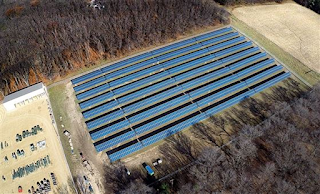
A new wind power project looms on the horizon for 2017. If built it will be the first large wind generation to go up in Wisconsin project since Glacier Hills in Columbia
County. All told, nearly 50 wind turbines could be built and placed in
service in Lafayette County east of Platteville, according to Vanessa
Tutos, government affairs director for project developer EDP Renewables.
The project enjoys strong support from local landowners.
Media coverage of the new wind project:
“New wind farm coming to Lafayette County brings boost to WI wind energy industry”
http://www.wkow.com/story/31459659/2016/03/13/new-wind-farm-coming-to-lafayette-county-brings-boost-to-wi-wind-energy-industry
“Wind farm drought may nearing end in Wisconsin”
http://www.jsonline.com/business/wind-powers-wisconsin-dry-spell-may-be-ending-b99683088z1-371880561.html
by jboullion | Mar 11, 2016 | Uncategorized
More information
Tyler Huebner, Executive Director
608-575-2201 (cell)
tyler.huebner@renewwisconsin.org
PSC Approves Madison Gas & Electric Community Solar
|
Eau Claire Electric Cooperative’s 2015
872 kW Community Solar Array |
Madison, WI – March 11, 2016
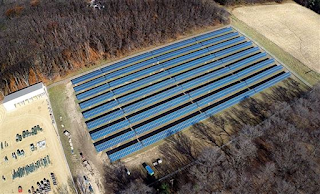
Today, the Public Service Commission of Wisconsin, which regulates the state’s utilities, approved a Community Solar project for Madison Gas & Electric (MGE). “Community solar” is a single, larger solar project in which a large number of people collectively share in the cost to build the project and share in the benefits of the solar energy production. The MGE project will be 500 kilowatts and will be placed on the roof of the Middleton Operations Center in Middleton, WI. MGE estimates that 250 people will participate in this project.
MGE joins a host of other electric providers offering community solar in Wisconsin, but this project differs from the others in two key ways:
– Participants will pay a small up-front fee of 10% of the cost per solar panel, as opposed to paying the entire fee for a panel at once
– Participants will then pay a 12 cents per kilowatt-hour rate for the solar energy generated by the Middleton array for up to 25 years. This is higher than today’s energy-only rate. But standard electric rates are expected to rise over time and exceed the 12 cent energy-only rate in about 10 years, meaning customers will start saving money at that point. (Both standard rates and the solar rate will also see 3-4 cents per kilowatt-hour in distribution charges.)
MGE structured its program differently because it has different customer demographics and looked for a program option that would not require a large up-front fee.
“Solar energy development improves Wisconsin because it creates jobs and increases local, secure, and clean energy,” said Tyler Huebner, RENEW Wisconsin’s Executive Director. “Adding options for more customers to participate in solar is a smart business move for MGE. Nearly 90% of Wisconsinites want more solar power, but only about 1 in 4 customers can put solar on their own property. Community solar programs like this enable many more citizens to participate in building a clean energy economy. We congratulate MGE on gaining approval for this novel community solar program design, and we hope it is successful.”
MGE’s application and supplemental responses are available in Docket 3270-TE-101 at the PSC’s website, http://psc.wi.gov/.
by jboullion | Mar 10, 2016 | Uncategorized
Will Dane County see its first community solar project? That all depends on the Public Service Commission’s decision on Madison Gas & Electric’s application to build a 500 kilowatt array on a brand new building owned by the City of Middleton. The PSC will decide tomorrow, March 11.
Below is an article from today’s Isthmus written by Cara Lombardo on the proposed MG&E project.
Keep on the sunny side
|
Eau Claire Electric Cooperative 2015
872 kW Community Solar Installation |
Adam Gusse, vice president of H&H Solar in Madison, hopes his employees can start putting solar panels on the roof of Middleton’s Municipal Operations Center this June. Construction would take a month and a half and result in a solar panel array that would provide 500 kilowatts of power to up to 250 homes currently served by Madison Gas and Electric.
The project just needs approval from the Public Service Commission.
MGE expects the PSC to rule on its proposal for a solar energy pilot program by the end of the month. While community solar projects have cropped up across the state, MGE’s project would not only be the first in Dane County but also the first south of the Wisconsin Dells.
Bradley Klein, an attorney at the Environmental Law and Policy Center in Chicago, says Wisconsin has lagged neighboring states when it comes to adopting solar energy. Minnesota, in particular, is already operating community solar projects on a large scale.
“In Wisconsin, for one reason or another, it’s been hard to get the commission excited about this in the way that we’re seeing in many other states across the country,” he says.
But Klein says the MGE proposal is “a good sign” for the state, and that creating strong, stable policy to help the market grow should be a priority.
Few utilities were prepared to invest in solar energy until the price dropped by 60% over the past four years, which is driving utilities to consider owning solar themselves.
Michael Vickerman, program and policy director at RENEW Wisconsin, an organization that advocates for renewable energy, says MGE is very interested in solar energy. “What they would really like to do is just start building solar,” he says. “But right now, the PSC’s position is, ‘Utilities don’t need more generating capacity.’ If there’s no need for these arrays, then the next thing they’d look at is, if a utility goes ahead and builds them, will this add costs to other ratepayers? That’s the lens through which they look at these very modest proposals from investor-owned utilities.”
RENEW Wisconsin commends electric providers who are trying to offer a choice despite what Vickerman calls a “vacuum of policy” in Wisconsin with respect to the environmental and economic benefits of solar energy. Because the benefits haven’t received proper consideration, he says, people who want solar energy will have to pay a little more, at least initially.
Community solar allows customers to source solar energy from centralized solar panel arrays instead of having to install panels on their homes. More than half of homes are unfit for solar panels, either because the roof is shaded or not properly oriented, and community solar allows for much larger arrays.
Customers who choose to participate in community solar arrangements typically pay an initial subscription fee, which can be a few thousand dollars depending on the investment size, to fund construction. Each month, the project’s energy output is measured, and customers receive reductions on their bills based on the amount of energy generated from their shares of the array. It usually takes more than 10 years for monthly discounts to cover the initial investment. But for many, it’s an easy way to support clean energy.
MGE’s proposed project is slightly different: Instead of selling shares of the array, MGE would own it and sell customers shares of the array’s output. Under this arrangement, smaller investments would be possible, and upfront costs would be significantly lower, around $380 for an average household subscription of 2 kilowatts.
Participants would pay a level rate of $0.12 per kilowatt-hour for energy produced from the panels; the default rate is around $0.095 per kilowatt-hour. However, the solar rate would be locked in for 25 years.
Eight community solar projects currently exist in the state, six of which are rural co-ops not regulated by the PSC. Dairyland Power Cooperative, which is based in La Crosse, and Xcel Energy have both announced plans for solar projects that would nearly double the capacity of solar energy in the state.
Gusse says the project, if approved, will build on the growth of solar energy in the state and generate even more interest: “It will be exciting to see if it gets through the approval process.”
by jboullion | Mar 3, 2016 | Uncategorized
RENEW Wisconsin’s advocacy has once again made the difference for a renewable energy victory.
The Public Service Commission of Wisconsin, the state agency that regulates electric utilities, and We Energies have decided not to appeal our October 2015 Circuit Court victory. RENEW Wisconsin partnered with The Alliance for Solar Choice, a national solar energy advocacy association, on this lawsuit. David Bender of Bender Westerberg LLC represented both groups in this matter.
The October 2015 Circuit Court decision struck down a new charge that most customers who generate their own power, whether through solar panels, small wind, biogas, hydropower, or other sources, would have faced starting in 2016.
The PSC or We Energies could have appealed that Circuit Court ruling, but they have chosen not to. That means We Energies’ new net metering service approved in 2014 will take effect, but without the PSC-approved “capacity demand charge” that would have reduced savings from newly installed residential solar systems by 30%.
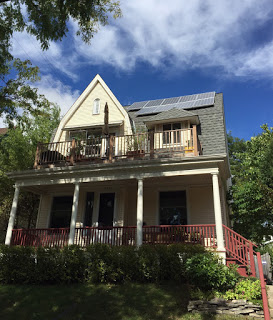 |
| Halvorsen Home Solar Installation in Milwaukee, WI |
In addition, the new net metering service sets a much higher cap for project sizes that can participate in the net metering program. The cap is now set at 300 kilowatts (kW) of AC power.
The previous cap was 20 kW, which RENEW had challenged in court following We Energies’ 2012 rate case. The 300 kW ceiling for net metered systems was proposed in 2014 by We Energies in response to our previous Circuit Court victory.
All told, our two court victories have added up to the following net metering service terms:
– Project size up to 300 kW AC, the highest cap allowed by any utility in Wisconsin
– Monthly “netting” of consumption vs. production (RENEW advocated for annual netting but did not win this point from the PSC in 2014)
– No extra charge imposed on customer-generators
We Energies typically files a new rate case every two years. If that trend continues, its next rate filing would come in Summer 2016. You can count on us to prepare for that filing along with others proposing changes to rates and distributed generation services.
Stay tuned!!